Tuesday, November 20, 2012

GS1 Technology Day: Nano, robots, humanoid reproduction

For the first time the leaders of the GS1 EPCglobal Board of Governors met at ETH Zurich for discussing future directions of RFID and barcode technologies. As part of this meeting, we organized a technology day which featured current develops of our labs associated companies and groups (find presentations and detailed agenda here).
In addition to our own work we could also invite renown keynote speakers from ETH Zurich.
Prof. Dr. Bertram Batlogg talked about recent developments of nano-technology and shared some insights about emerging display technologies.
As part of this program we had also the chance to meet Prof. Dr. Raffaello D’Andrea who motivated his research on controlling robots by sensors by the example of the steam engine controlled by a speed limiter.
Raffaello showed the tremendous developments regarding miniaturization when he compared their most recent quadrocopter with the table-sized model of a decade ago.
However, during his robot air-show the title of his talk "Controlling the artificial" become even clearer: Raefaello showed his trust into his technologies when he took a seat in his Flying Machine Arena and his students started the show, sometimes closely above his head.

In the first demo our visitors could control the helicopter with a stick by gestures. The system ensured that the helicopters did not collide with the walls or crash down because of too hectic movements. Other demos showed the ability of balancing a standing stick on the helicopter, coordinated movements of groups, kinect gesture control and the famous ball juggling (see here). Thus, this demonstration made me confident about getting the next doener delivered by drone pretty soon....
Finally, Prof. Dr. Markus Gross talked about how to visually reproduce the real-world based on special effects in several animation movies. He reported about the ability of 3D-scanning of still faces and reproducing movements with 7 artificial muscles in contrast to the natural 35 muscles. His prophecy was that in about a five year's time horizon simulated face-movements would be indistinguishable from the real. Thus, Holywood stars would already start protecting the rights on the visual appearance of their bodies, as movements can be done by the computers later rather easily and more cost-efficient.
In the second part of his talk Prof. Gross talked about humanoid robots that would mimic actors in amusements parks. Based on 3D scans and 3D printing faces can be modeled quickly. As a commercialization of this technology he showed customized barbie puppets carrying faces of the corresponding children. Technological progress sometimes can be fascinating and scary...


Friday, November 16, 2012

White collar crime


In my lecture management information systems Michael Schermann from Lehrstuhl für Wirtschaftsinformatik of Technische Universität München presented on the incentives of in-company crime and instruments for preventing it.
He started off with the traditional explanation of crime where criminals would simply balance between their crime incentive and the opportunity of being punished. Thus, high punishment would be enough to move the balance and ban crime...
However, from practice and from recent experiments we know this does not really hold. People rather have a moral account from where they withdraw and upload credits for their activities: if you buy green, you're more likely to steal...[1].
Furthermore, the simple cost/benefit analysis of fraud is also overwritten by an inner concept relating to fraud of users. It could be shown that fraud outside one's peer-group is less accepted than one's inside peer-group [2].
As example of fraud Michael listed corruption, higher billing of services/products, and non-cash fraud, e.g. manipulation of salaries - he said 15% of salaries would be adjusted higher than they should be. This shows that the traditional concept of incentive-punishment does not hold and is rather being replaced with an inner self-concept of values: if people park illegally, they are more prone to donate to beggar - in order to compensate their wrong behavior by adjusting their moral inner account.
Interestingly, most fraud is detected by hints of others. Thus, companies have started introducing whistle blower channels in order to collect these hints in a more systematic way. Michael proposed to translate business strategy into core values, which have to be lived up by top-management. There should be a clear list of don'ts to be avoided in companies. Control in companies can focus either on input (if output is hard to measure, e.g. as in research) or on input (e.g. sales).
The practical challenge, however, is to smartly balance between burden and effect. IT can help to better manage and control performance and coherence in order to be more responsive to risks, e.g. software can help to crunch down 126k of suspect emails down to a 1,2k messages.
Michael's slides can be found here.
 
[1] Nina Mazar and Chen-Bo Zhong: Do Green Products Make Us Better People? Psychological Science February 2010 , first published on March 5, 2010 
[2] Gino, F., Ayal, S. & Ariely, D. (2009). Contagion and differentiation in unethical behavior: The effect of one bad apple on the barrel. Psychological Science, 20 (3), 393-398.
ariely: coke was gone, dollar where there -) distance to money increases crime

Tuesday, November 6, 2012

Internet of Things 2012 in Wuxi


As a program co-chair I had the opportunity to visit the recent IoT conference hosted by Fudan University in Wuxi.
Elgar Fleisch opened IoT2012 by reviewing the potential of IoT to add things-generated data to the gulf of human-generated data. He listed standards, biz models, ownership management, and human behavior change as future research topics within the IoT domain.
Li-rong Zheng, general chair IoT2012, thanked the various organizers and conference chairs. Then, Junyu Wang reflected on the importance of Wuxi as the center of IoT in China walked through the program. A rigor selection of papers yielded an acceptance rate of only 24.7%.
Finally, I had the pleasure to introduce Stefan Ferber from Bosch who is not only a professional but also passionate private user of IoT technology (see his smart home here). In his opening keynote of IoT2012
Stefan Ferber (see his slides) introduced to various  IoT projects going on within Bosch and reflected on the significant differences between old and new economy in terms of organization structure, decision processes and effectiveness. He showed how technology finally helped to disrupt established hierarchies allowing for more flexible and dynamic patterns of collaboration. By refering to Conway's law ("organizations which design systems ... are constrained to produce designs which are copies of the communication structures of these organizations") he underlined the importance of changing organizations correspondingly along the technological innovations.

 
Stefan used the very strong metaphor colliding galaxies to express the impact of IoT to organizations. He introduced the geigermaps project as an example of how a grassroot movement of people connecting their sensors to each other can provide a much faster and more fine-graine picture on radiation than the official authorities could or wanted to provide during the Fukushima accident. As a second example of grassroot movement he refered to the iot bill of rights signed during the open iot assembly by various stakeholders of IoT as a free movement of concerned individuals outside regulatory bodies.
Stefan went on reflecting on the properties of IoT-enabled products. Originally, purposeful systems were handled and controlled by their owners: the owner was responsible, the producer only provided the tool. However, once the tool becomes smart this might change: the tool's functionality grows outside its original physical purpose and follows the digital configuration the producer has set-up. Thus, the producer becomes responsible as well (see also his blog post on his talk).


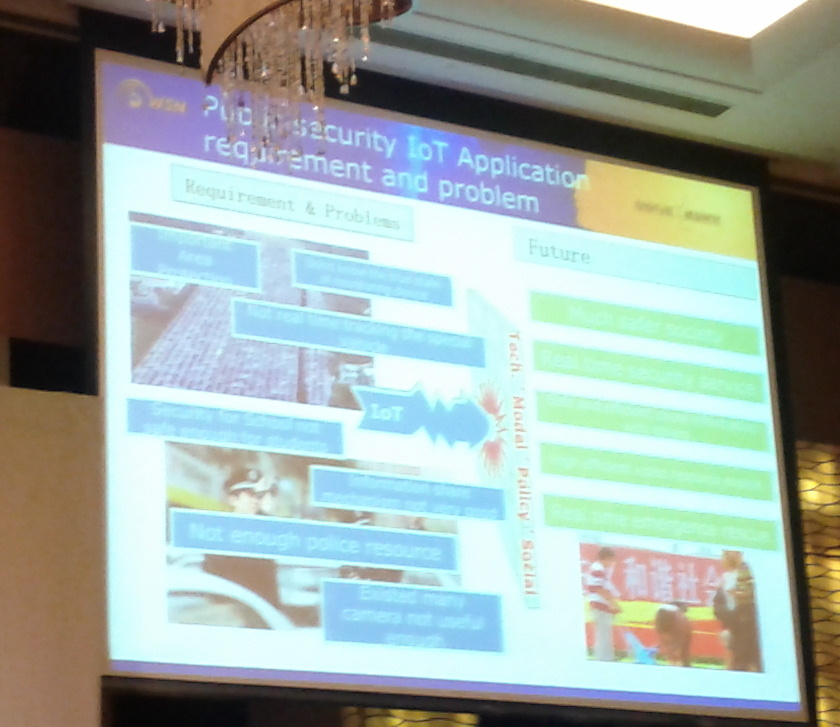
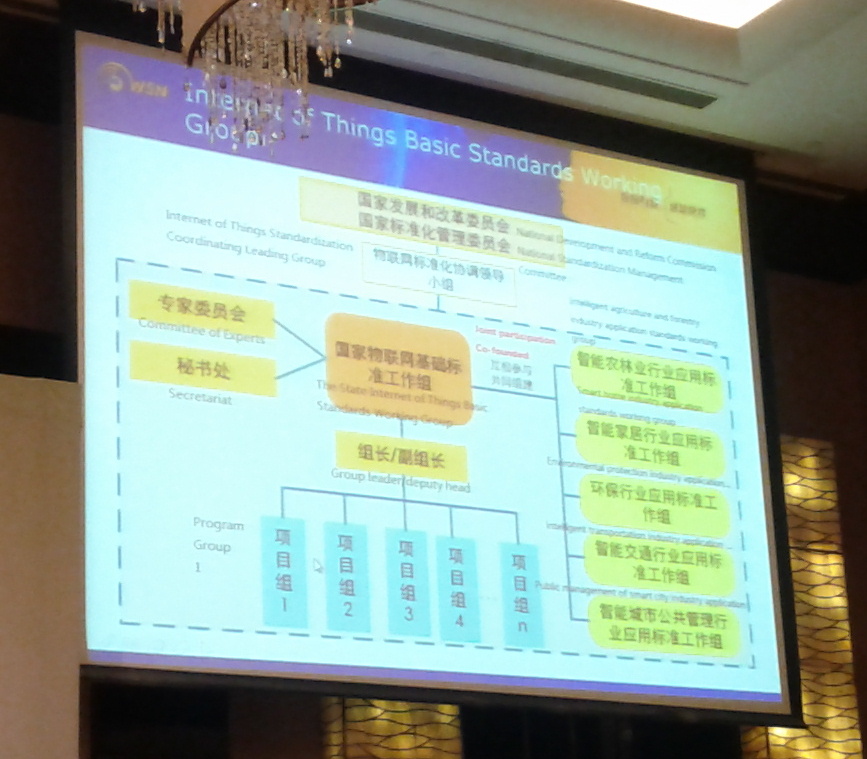
Haitao Liu, Wuxi SensingNet Industrialization Research Institute talked about  IoT projects in China which focus on standardization and  applications, such as resolving traffic jams, better public transportation and parking guide systems. As part of public security initiatives he mentioned the "Golden Shield Project" which aims at improving communication of security data and management of capturing technology as cameras in public areas. He also mentioned smart homes as an emerging trend in China which would pose challenges of integration and interoperability. There would be also several activities of environment monitoring where single measurements stations are being gradually replaced by swarms of collective pollution meters. Furthermore, IoT projects in China would also focus improving efficiency of agriculture and food safety.

Overall, it became pretty obvious that IoT in China clearly relies on central power and control leveraging the the central governance system. I'm pretty sure that sooner or later this approach will collide with the rather distributed technical nature of IoT. Mr. Liu concluded his talk by referring to the current bottlenecks of limited understanding of requirements, insufficient standards and prevailing information silos. He mentioned IoT as a big market for Chinese companies for transiting from traditional manufacturing to highter value IT businesses. The Chinese government sees IoT as new enginge to accelerate the development of Smart City construction for upgrading the industrialization in China.

Then the technical program started, the proceedings can be found here. Overall, the conference had about 300 visitors. According to comments I received from visitors the mix between large variety of  scientific and industrial workshops, demos and posters was highly appreciated.
Finally, the show goes on in 2014: see you all at IoT2014 hosted by Prof. Sanjay Sarma at MIT.

Friday, October 5, 2012

Semiotics and Internet of Things

I first had to find out about Semiotics before I could participate in the Panel on "Semiotics and Informatics: Syntax, Semantics and Pragmatics of Knowledge Management in a Social Context" at IC3K'12 conference in Barcelona.
I was really curious about how semiotics - studying about properties and functions of sign - could be applied to guide interpretation of phenomena in context. Kecheng Liu illustrated how different semiosis between system user and system analysist can create a gap of understanding which may cause many IT projects to fail.
In my contribution I proposed to apply Semiotics for interpreting things as parts of situations and contexts of use. Furthermore, by analyzing available Master Data of products Semiotics could help to derive possible uses of objects which could instruct robots about how to use those - as an alternative to ontologies.
Finally, in I used the opportunity in my keynote to draw the attention of knowledge management to thing-generation data (in addition to people-generated they work on today).


Thursday, September 27, 2012

RobIoT @PICNIC12 - when robots meet IoT

Organizing RobIoT at Pic-Nic 2012 provided me the opportunity to visit the Pic-Nic Festival for a first time. It took place in the Eye in Amsterdam. I was asking continuously but apparently it is hard to say who the audience of this conference is: it is not really business, not really academia, it is more about hackers and artists presenting work to people from creative media.

Before our workshop started I could attend an opening talk of George Dyson who gave a fantastic talk about the history of IT and the continuous battle of good vs. evil in research, as IT in a way was also part of the development of the nuclear bomb. Byron Reese gave a rather frantic talk about how IT and media has freed our lifes from pre-defined marriages/jobs/hobbies/styles. I liked this introduction but was a bit disappointed about the following yes-we-can gobbledygook, such as technology would keep our society alive and his rather cynical finding of "hunger is just a technological problem".
Rich Pell from the Center for Postnatural History talked about life which was less natural but more cultural. He called intentionally altering of biological life as animal hacking. He emphasized how cooperations as Syngenta etc. would secure their gene-modified seeds: through obscurity, terminator gene preventing an organism from reproduction, and a non-breeding agreement preventing the farmer from breeding seeds through a legal contract becoming effecting after the seeds' bag has been opened...

Additionally, I could also visit some interesting Demos such as Mobile Thrill which provides experience to your mobile phone: you place your phone on a conveyor build with video switched on, the phone disappears and comes back with its "impressions". Additionally, I also liked the mobile bench.


Rob van Kranenburg opened RobIoT by predicting the advent of robots in our daily lifes anytime soon. Thus, instead of building nightmarish scenarios of mean robots taking over the world, he proposed thinking more proactively about how we can turn robots into something useful and joyful as the topic for this one day workshop. How can we fuel thr vision of robots and Internet of things with positive scenarios?
Gerald Santucci was talking about future robots as easily programmable devices that will empower people to write apps for them the way they do with PCs and smart phones.
Alessandro Bassi compared Asimov's Laws of Robots with the “IoT laws” of Adam Greenfield. He also reminded us that Asimov's Laws, e.g. "A robot may not injure a human being", are not obeyed if we look at the drones killing people in Middle East.
Stefan Gessler gave an overview on the variety of robots of today starting from the dumb vacuum cleaner robot to the humanoid robot. How was elaborating on how to link robots and proposed IoT as a technology for reducing costs for letting also robots communicate.
Karmen Franinovic talked about active material as the basis for activating things. I liked her more integrated perspective of making things active themselves instead of only having robots as separated mediators for actions.
Heico Sandee talked about how robots can give hands to the internet and how active actuators could "actify" passive objects. In order to make that happen research would have to focus on representing, exporting, discovering, executing and matching robot capabilities to real-world tasks and needs.
Finally, I talked about how robots could provide the arms and legs for the Internet of Things. I proposed to start with an initial set of basic activities robots could provide, such as moving or searching things. Then, from those basic activities atomic  tasks as press/touch/carry/etc. should be derived. Additionally, infrastructure requirements such as localization, hand-over to robots should be solved. And finally, robots should be integrated with Internet of Things, e.g. deriving object use from barcode master data.


In the very active discussion with our roughly 40 participants I learned that it probably will not be so so much about robots but rather about actuated materials as pointed out by Karmen. Concerning tasks it may more about tasks humans do not want do, e.g. ironing/car-driving. However, this of course highly depends on personally preferences, too. Robots may also used in combination with persuasive technologies to persuade human users to achieve a personally set goal.
There were also critical comments about why we would only think of privileged situations. Are there other cases, too. Or robots the machine staff of the rich? Are disabled not interesting when it comes to business cases?
Also, some participants mentioned that actuation to a large extend might not be really so much different from screens when it comes to present information or notify the user in more subtle ways (e.g. tapping on ones shoulder).
We also had some good discussion about what we do not want robots to do, what about taking care of your kids? Could robots allow you to work more, which counters of Karl Marx' initial idea of robots allowing you actually to work less.
We discussed whether DIY-robots would be necessary to spark innovation. Certaintly, DIY robots prove the state of maturity of a technology. We even had a moving plant-robot in the workshop which was build for less then 5 EUR...
And finally the discussion closed with questions about responsibility of robots, whether it would be the user, owner or manufacturer, what about garage doors killing people?
I see robots as an emerging topic to be considered with in IoT, see also here [1,2].

[1] Kevin Ashton: Humanizing Robots, RFID Journal, September, 2012.
[2] F. Michahelles, Rob van Kranenburg and Markus Waibel : Enlisting Robots - Once robots are integrated into the Internet of Things, they can perform tasks automatically., Inside the labs column in RFID Journal, August, 2012.

Sunday, September 23, 2012

3rd Research in the large workshop, this time at MobileHCI2012

Having visited already the previous serious of Research in the Large (2010, 2011) I was very much looking forward to meeting the large researchers again investing approaches, tools, research questions for conducting research by deploying apps.
This year I was talking about three topics. In the first paper [1] we investigated the compliance of users of updating their mobile apps. We analyzed the lifecycle of various versions of a released app and found that after one week still half of the users run an old version. Thus, we recommend that developers actively notify their users inside the app to conduct an update.
Throughout the workshop we received interesting comments regarding whether could differentiate within the non-updaters between active and no-longer active users. Furthermore, it could be interesting to cluster the users by age, categories of apps etc. in order to find out whether updaters and non-updaters share certain characteristics. Finally, it would be interesting to track whether the newly introduced 'update all' feature in Android increases the compliance. We might also collect updates histories of apps from appbrain.com and compare our results with other apps.
Then I talked about our analysis of apps [2]  (based on appaware.com stats) available in the Android market. We analyzed the volumes of apps being downloaded corresponding to the overall sales. In contrast to amazon which largely live on the longtail of products, the Android market clearly is a hit market, where the most popular products contribute the largest parts of the sales. Our conclusion was that niche apps are still hard to find on the Android market (in contrast to the recommender systems revealing niches in amazon), thus research should focus on developing recommender systems. Furthermore, we found there is a significant amount apps generating large revenues with rather low download numbers by premium prices. Thus, developers should consider to increase the price of their apps significantly.
Finally, I presented NFC Heroes [3] we motivates users by a card trading fight game to upload information about deployed NFC tags.
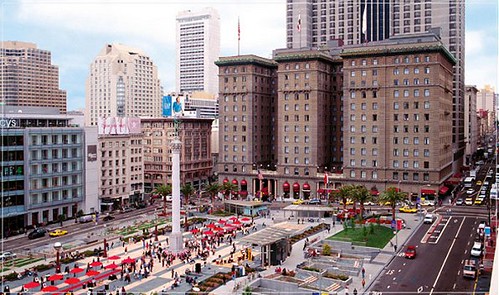
The feedback we received from the workshop to give more hints to users where NFC tags are, e.g. information about local deployment activities as NFC tags at bus stops in San Francisco. Later, we might also building a service listing places and services of NFC tags in order to educate and inform users where they could use the NFC feature. Finally, we should consider to also listen to NFC intends  from other apps on the phone in order to capture any NFC interaction of the user's phone.

 In the workshop we had 7 talks in total which all latest for only 7min followed by 7min of discussion. This gave us enough time in the afternoon for some more in depth discussion about how to recruit users and what to learn form app stores.
To start off the discussion Frank Bentley first motivated why to do field studies at all (compared to lab studies): investigate real usage, impact of new systems, usability, inspiration, qualitative understanding, or quantitative confirmation of a previous small study.
Then Frank listed various option for recruiting users: in addition to the practice of small studies via mechanical turk, craigslist, posters in stores, snowball sampling, classmates and lab-mates, in the large we can populate the what's new section app stores, app store ads, targeted Facebook ads, re-tweets, personal tweets, presentation, and advertising. Another idea mentioned was to treat user's privacy as the user currency, the user owns and can decide to release for receiving specific services/benefits in return. Finally, our discussions revealed that either way user are recruited it is essential that papers clearly document how this was done. This is the only way that readers and reviewers can judge on the validity of the results.
The second part of the discussion focused on what kind of data and which research questions could be specifically tackled by doing research using app stores. On the one hand we get stats about downloads and locations of apps, logs of button presses, and partly demographics. However, what we don't get is the context of use and insights into why people did or didn't an activity. Overall, we are limited to tasks users in the wild want to do which may limit to tasks which are fun or particularly useful. Finally, a remaining question is as the number of apps in the markets develops and matures, whether the effort of releasing a decent app would be still feasible in near future.
David Aymann Shamma reported about his experience collecting and analyzing data from a chatting app for watching videos remotely together. David focused a lot on responsibility and ethics of treating the data being gathered throughout the project. Handling this massive amounts of data and also highly sensitive data would be a new dimension of what we as researchers would be usually used to. David also recommended to be generous and consider deleting all the session which appear to be odd or incomplete.

Overall, I really enjoyed meeting all these people sharing an interest for doing research in the large. I'm looking forward to help running this next year again. It's probably also time to come with a manifesto or guidelines describing how to do research in the large. Collective experience of researchers in the domain (e.g. [4]) should motivate the community to consider this new research method going far beyond the established modes of user studies.

[1] Update Behavior in App Markets and Security Implications: A Case Study in Google Play, Andreas Möller, Florian Michahelles, Stefan Diewald, Luis Roalter, Matthias Kranz, 3rd workshop on Research in the large (at MobileHCI 2012), San Francisco, September 21, 2012. [pdf]
[2] Examining the Long Tail of Android Market, Nan Zhong, Florian Michahelles, 3rd workshop on Research in the large (at MobileHCI 2012), San Francisco, September 21, 2012. [pdf]
[3] NFC Heroes – Observing NFC Adoption through a Mobile Trading Card Game, Lukas Murmann, Florian Michahelles, Matthias Kranz, 3rd workshop on Research in the large (at MobileHCI 2012), San Francisco, September 21, 2012. [pdf]
[4] My App is My Experiment: Experience Studiesin Mobile App Stores, Henze, N., Pielot, M., Poppinga, B., Schinke, T., & Boll, S. (2011). International Journal of Mobile Human Computer Interaction , 3 (4), 21.

Talking about the state of RFID at RFID Sec 2012


 I was invited by Jaap-Henk Hoepman to give the keynote at RFIDSec'2012 Nijmegen..
RFIDSec has been established eight years ago as very focused series of workshops standing of their own emphasizing security under the lower-power, low-computing capabilities, low-cost of RFID technology. It has been quite a while ago I attended this workshop back then when we investigated RFID as a tool against anti-counterfeiting [1]. Giving the keynote provided me with the privilege to show the privacy slide first at the conference. Other speaks pulled out the very same slide later again...we should really think to draw a new slide about this topic;)
Thus I reviewed the history and development of RFID in my talk "When will RFID embrace our everyday lifes?" (see my prezi). I should what happened and what not happened: no RFID tags on items in the retail stores. I provided some hope and asked for patience, as reviewing the history of barcode also revealed very long development and deployment cycles. Finally, I proposed to drive adoption by identifying clear business cases, providing out-of-the box tool for easing deployment and, ultimately, to focus on user experience. For more details see also the conference report of Jaap-Henk Hoepman which almost provides a transcript of my talk (see here).

 [1] Lehtonen, M., Staake, T., Michahelles, F., Fleisch, E.: From Identification to Authentication - A Review of RFID Product Authentication Technique, Workshop on RFID Security -- RFIDSec 06, July 2006.