Showing posts with label mobilephone. Show all posts

Thursday, December 13, 2012

Stephan Karpischek defended his thesis on mobile barcode scanning and quality of product master data

Stephan Karpischek is, after Irena Pletikosa, the second the PhD student this week and my fifth in total successfully defending his thesis. Congratulations, Dr. Stephan Karpischek!
As his co-referee Sanjay Sarma from MIT could not attend in person, Stephan defended his thesis in a sophisticated conference room at ETH where we had high-quality connection to MIT. The quality of video and sound was amazing and prove that some travels can be indeed eliminated by these technologies.
Stephan outlined four contributions of his thesis: the implementation of the open-source mobile barcode scanning app my2cents.mobi [1], the proof of incorrect master data yielding lower usage of mobile apps [2], the introduction of a
method to measure correctness of product names and its application to public master data sources [3]. Additionally, Stephan also did
some remarkable analysis of user behavior of mobile bargaining [4] and developed one of the most renown Swiss apps [5] , Swisspeaks. However, both results did not really fit any more in his thesis "Mobile Barcode Scanning Applications for Consumers" (will be available in a couple of months here).
 In the Q and A section of his defense Stephan prove that roughly 2% of today's master data available in online data pools amazon, google, afili.net etc. are wrong, dillute the brand image and could yield financial losses. This result provides a fact-based justification of the GS1's emerging Trusted Source service [6] which aims at providing brand-owner approved master-data. He also gave a perspective of a future master-data monitoring service that brand-owners could use to measure their appearance and abuse of their barcodes by other parties on the network...
Stephan, it has been a great pleasure to working with you and I really enjoyed the inspiring discussion with you. I wish you good luck in your new job!


[1] S. Karpischek, F. Michahelles, E. Fleisch, my2cents – enabling research on consumer-product interaction. Journal of Personal and Ubiquitous Computing. Springer, 2011, [doi:10.1007/s00779-011-0426-9].
[2] S. Karpischek, F. Michahelles, my2cents - Digitizing consumer opinions and comments about retail products, Internet of Things 2010 Conference (IoT2010), 29 November - 1 December 2010, Tokyo, Japan.
[3] S. Karpischek, F. Michahelles, E. Fleisch, The Not So Unique Global Trade Identification Number - Product master data quality in publicly available sources (Extended Abstract). 14th International Conference on Electronic Commerce (ICEC'12), 7 - 8 August 2012, Singapore.
[4] S. Karpischek, D. Santani, F. Michahelles, Usage Analysis of a Mobile Bargain Finder Application. 13th International Conference on Electronic Commerce and Web Technologies (EC-Web 2012), 3 - 7 September 2012, Vienna, Austria.
[5] S. Karpischek, C. Marforio, M. Godenzi, S. Heuel, F. Michahelles, SwissPeaks - Mobile augmented reality to identify mountains, Let's Go Out: Research in Outdoor Mixed and Augmented Reality.  Workshop at the International Symposium on Mixed and Augmented Reality 2009 (ISMAR 2009), 19 October 2009, Orlando, Florida, USA.
[6] GS1 Trusted Source of Data, Project Report, GS1, July 2012 [pdf]

Monday, December 3, 2012

NFC Congress 2012

 It was the third time I attended the NFC Congress at FH Hagenberg. I was happy to meet so many people still believing in the opportunities of this technology even though actual deployment is still progressing slowly. I attended the congress one day before the announcement of Apple’s iphone, but there seemed to be pretty much consensus that Apple will not be a driver of this technology either.
 It was good to see how Nokia’s development of NFC finally got integrated into Microsoft’s Proximity API of Windows 8 which markets NFC as user experience instead of technical modes and parameters. However, the importance of windows mobile among Android and iOS still remains speculation. Payment is still seen as the main driver – or currently the main show stopper – of NFC. Several talks pointed out the roadmap for NFC as starting with wireless cards being rolled out mainly in eastern and southern Europe, next would be NFC stickers on phones, and finally the full integrated into the phone.
There the challenge will be to group service around payment such as coupons, loyalty, promotion, transport in order to incentivize consumers to switch from established payment methods – in Germany mainly cash – to mobile payments.
Finally, NFC was also proposed for micro-merchants as an alternative to transaction terminals, I enjoyed the split screen application for taxi-drivers presented by the Sparkassen Verlag Overall, the time horizon of greater adoption still remains unclear. Most participants, however, shared the believe that NFC would come sooner or later, mostly driven by the introduction of wireless cards which might be substituated by NFC later. Thus, I’m already looking forward to the NFC 2013 workshop which is technically co-sponsored by IEEE Switzerland Section and will take place in Zurich, Switzerland.

Tuesday, March 13, 2012

My picks from NFC2012


Together with Joseph Langer and Tuomo Tuikka I was involved in the organization of another issue of the NFC workshop series.
Jukka Riekki open the workshop by giving a keynote on NFC as an interaction method in interactive spaces. He showed various examples where the user interface is spread in the environment [1]. The challenge he outlined here is that the user first has to find the interface!
Accordingly, Jukka proposed a graphical language which would make the user aware of opportunities of interaction. He reported about studies with kindergarten children who learned reading the name tags by touching them with an NFC phone and listening to the audio voice [2]. His learning from that project was that the early simple NFC phones have the better usability: the reading zone of the antenna is more obvious and the phones are better to grasp.

Stefan Gruenberger from Hagenberg presented on the challenges of integrating NFC into existing electronic ticketing standards, such as VDV. Reading his paper [3] I got the impression that ticketing is a literal killer application by rather killing the application...

Michael Roland shared illuminating insights about the security challenges of emulating smartcards on smart phones. He reviewed [4] the various vendors' API's, such as JSR 177, Nokia's JSR extensions, Blackberry and Android. He concluded that the access to the smart card application via the various mobile phone operating systems should be better protected by additional user interaction, e.g. granting apps access to the payment function by entering a dedicated PIN. The implementation of this feature has to be moved beyond the operating system level down to the hardware level. Otherwise, relay attacks could make use of the GSM network to remotely access other user's secure elements to process payment without their notice.

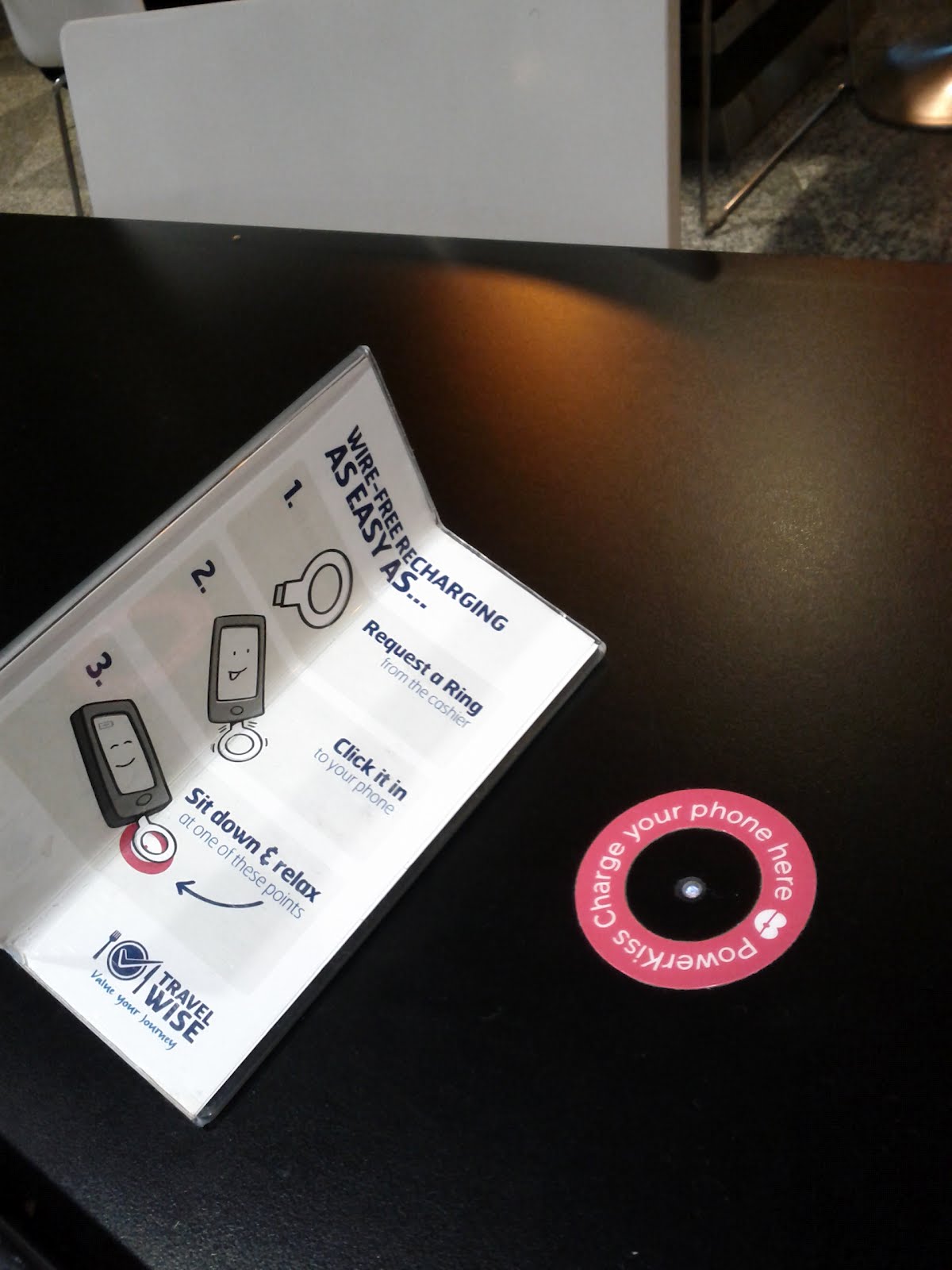
Esko Stroemer presented a new application for NFC, using the NFC standard for wirelessly charging devices. While he had to admit that powerage at the NFC frequency will be orders magnitude lower than standard wireless chargers (0.1 W in contrast to 5W), he presented convincing usage cases. erhaltladung, small devices, and finally the combination of NFC services and charging, as paid charging. Esko presented some prototype proving the concept. He outlined the design of RF systems that perform both at low coupling (standard NFC case) and high coupling (charging) as challenges. Later, at the airport I already saw a wireless charging station still requiring an external ring-antenna plug...

During the side discussions I learned that the NFC killer app payment is still hardest one due to the competing interest of the involved parties: the credit card issuers, such as mastercard/visa own the payment infrastructure in the stores. Unlike in the traditional cards business the user tokens are not owned by the issuers but by the handset manufacturers. Thus, this parties have to agree on the conditions. The implementations have to be at least as secure as the trusted card platform (which is hard to achieve in current implementations granting the mobile OS's direct access to the payment schemes as roland has pointed out). This process of consolidation might be still going for a while and then hopefully pave the ground for the flourishing user experience enhancing apps as Rukka has pointed.

The future of NFC is hard to predict, the future of the NFC workshop is rather clear: NFC2013 will be at ETH Zurich!
It will be exciting to see how NFC will develop and whether adoption will finally take off...CU in Zurich!!!

[1] Hosio S., Jurmu M., Kukka H., Riekki J. & Ojala T. (2010) Supporting distributed private and public user interfaces in urban environments Proc. 11th Workshop on Mobile Computing Systems and Applications (HotMobile 2010), Annapolis, MD, USA, 25-30.
[2] Riekki J, Cortés M, Hytönen M, Sánchez I & Korkeamäki R-L (2012) Touching Nametags with NFC Phones: a Playful Approach to Learning to Read. LNCS Transactions on Edutainment. Special Issue on Interactive Digital Storytelling,