Tuesday, April 23, 2013

A short report about NFC 2013

As program chairs Josef Langer and Tuomo Tuika opened the Fifth International Workshop on Near-field Communication (NFC2013) in Zurich on February 5, 2013. I as the general chair introduced briefly about the previous hype on NFC and it's current loss against national football conference on google trends.
The goal of the workshop was to bring together experts on RF and smartcards technology, security, NFC-related applications,
services and business processes. We received 22 research paper submissions around these topics. A rigorous review
process was followed with each paper receiving three reviews from international experts of the program committee. Based
upon this process, thirteen full papers were selected to appear in these proceedings and to be presented at the workshop. This
resulted in an acceptance rate of 59% for 2013.
The papers covered a range of topics related to NFC payment and ticketing, security, retail applications, and NFC communication. 

Marcello Morean started off with a secure solution for mobile ticketing.
Christian Saminger presented a solution of ticketing using the inverse reader mode where the  phone acts as reader/write device whereas terminal emulates the nfc ticketing card. This approach works on any nfc without requiring a secure element.
Next, Gerald Madlmayr talked about the nfc payment ecosystem.
Michael Roland presented on hacking and fixing relay attacks against the google wallet. Ali Alshehri explained how to analyse coupon protocols using the CASPER/FDR framework.

Marcello Morena stepped in for his colleagues and reported about user-centered design process of developing an NFC museum app.
Mark Lochrie showed how to use NFC/checkins to curate music preferences. By reusing library cards the music could be controlled.


Gregor Broll reported about on-going work of displaying sugar saturation in products using multimodal feedback. Maali Alabdulhafith reported about how to use NFC to check for drug allergies and notify doctors and pharmacists accordingly. The system relies on the hospital's database entries but may trigger some false alarms if the DB is not properly curated.

All papers are available in the online proceedings as part of the IEEE Xplore libary.

Overall, it was an exciting workshop. It remains to be seen whether 2013 will be the year of NFC, after all the previous years have been suspects of this event already;)

IEEE Consumer Communications & Networking Conference - General Call for Workshops


***********************************************************
IEEE Consumer Communications & Networking Conference (CCNC)                  
 (Held in conjunction with the International ConsumerElectronics Show,       
 Las Vegas, January 11-14, 2014)                                             
                                                                              

 General Call for Workshops                                                                                            

***********************************************************


IEEE Consumer Communications and Networking Conference (CCNC), sponsored by the IEEE Communications Society, is a major annual international conference. Taking advantage of its co-location with the International CES (the world's largest tradeshow on consumer technology), CCNC is organized with the objective of bringing together researchers, developers, and practitioners from academia and industry working in all areas of consumer technologies. CCNC 2014 will feature high quality keynotes, plenary talks, panels, and tutorials.


The CCNC 2014 Organization Committee invites members of the research, development, and practitioner communities to submit workshop proposals.
Workshops provide a forum for people to discuss areas of special interest pertinent to consumer communications and networking with like-minded researchers and practitioners. Workshops aim at examining an area in a less formal, more open environment for the free exchange of views, and possibly in a more focused way than in the main track of the conference itself.

Topics of interest include, but are not limited to:
  • Communications and Signal processing for modern mobile devices.
  • Social Networking, CrowdSourcing and Participatory Sensing
  • Wearable Augmented Reality
  • Peer-to-Peer and Cloud-based Networking
  • Multimedia Networking, Services, & Applications
  • Smart Spaces & Sensor Networks
  • 3D printing
  • Personal Robotics
  • Security, Content Protection & DRM
  • Vehicular Networks
  • Green Communications & Computation
  • eHealth, Ambient Assisted Living
  • Home Energy Management
  • Telepresence & Telerobotics
  • Intelligent & Emotion-oriented Computing
  • 3D Imaging, Processing, Communications & Display
  • Innovative Multimedia Systems & Consumer Electronics
  • Information Integration & Data Analytics
  • Case studies of application deployments
  • Emerging Standardization Topics in Consumer Communications.

CCNC workshops will be organized on the first and last day of the conference (Jan 11 and Jan 14).

Proposal Format

The workshop organizers should submit a workshop proposal by May 31st 2013.
Each Workshop proposal should include:

  1. Name of workshop and proposed URL of site to host CFP, program etc.
  2. Theme of the workshop and topics of interest and how these related to the overall conference
  3. Names, affiliations,  and a short bio (up to 200 words) of the organizers
  4. Brief description (up to 1 page) of research, industry, and practitioners' topics of interest that the workshop will address
  5. Reasons why the workshop is of interest to the conference participants
  6. Audience: expected number of participants, potential program committee members
  7. Description of the publicity plan: how to attract participants and submissions
  8. Planned format: participant selection, time line, type of contributions, discussions and integration of non-presenting participants.
    •  Full-day workshops should aim for 8-9 accepted papers or invited technical talks. Half-day workshops should aim for 4-5 accepted papers or invited technical talks. Indicate the maximum length of the papers to be submitted.
    • If the workshop will include invited technical talks (i.e. presentation of a non-peer-reviewed paper ), the proposal should include a subset of invited speakers who are willing to attend and participate if the workshop is accepted.
  9.  If applicable, a description of past editions of the workshop, including: number of submitted and accepted papers, and number of attendees.
  10. A draft workshop call for papers with:
    • The names, affiliations, addresses, phone numbers and email
    • addresses of the workshop organizers, who should be experts in the related topics and preferably from multiple organizations.

All proposals and questions should be submitted to the workshop chair:
Florian Michahelles, ETH Zurich, fmichahelles@ethz.ch, subject: CCNC14 workshop.

Conference registration fees will not be waived for speakers at accepted workshops. The organizers of the accepted workshops will be responsible for paper reviewing and the workshop programs.

Workshop Proposals Due:  May 31, 2013
Acceptance Notification:    June 15, 2013
_______________________________________________
Florian Michahelles, fmichahelles@ethz.ch
CCNC 2014 Workshops Chair

Wednesday, March 20, 2013

The German perspective of IoT: Industrie 4.0

Last year in June I had the opportunity to join a workshop on the impact of Internet of Things (IoT) for the German industry.
The consensus was that Germany missed the developed of an app-industry and hard-ware development. Instead, Germany should rather focus on proprietary platforms, appstores, for machines, cars and smart home: app-stores for things. A new job profile, the IoT-mechanic, is emerging.


The overall goal of  IoT is to improve quality of life, sustainability and growth (hm...isn't growth the opposite of sustainability!?). IoT bears the danger of forgetting the human yielding a rigid and process-oriented life focusing on the beauty, bold and technophiles.

Instead, developments should be driven by industry focusing on health, energy efficiency and standardization. Research questions could be:
  • how to integrate the diverse and isolated initiatives of IoT into one coherent platform?
  • IP doesn't work for everything, iterative processes based on specific examples should help to develop alternatives.
  • who owns the platform?
  • vertical platforms should be developed to solve societal challenges: production, plant manufacturing, and machine development
  • horizontal integration to reusing technology
    • interoperability
    • discovery/self-organisation
    • open platforms for third parties, SME's
    • reference architecture for niches
Involved parties should be telco providers, device manufacturers, service providers and end-users.
Overall, platforms should help SME's to develop new services and create business and jobs. Open-source should allow communities to develop new services. The german government should provide the legal framework to include various stakeholders, protect their investment, yield services for the good.
I'm looking forward to the results of Industrie 4.0.

Thursday, December 13, 2012

Stephan Karpischek defended his thesis on mobile barcode scanning and quality of product master data

Stephan Karpischek is, after Irena Pletikosa, the second the PhD student this week and my fifth in total successfully defending his thesis. Congratulations, Dr. Stephan Karpischek!
As his co-referee Sanjay Sarma from MIT could not attend in person, Stephan defended his thesis in a sophisticated conference room at ETH where we had high-quality connection to MIT. The quality of video and sound was amazing and prove that some travels can be indeed eliminated by these technologies.
Stephan outlined four contributions of his thesis: the implementation of the open-source mobile barcode scanning app my2cents.mobi [1], the proof of incorrect master data yielding lower usage of mobile apps [2], the introduction of a
method to measure correctness of product names and its application to public master data sources [3]. Additionally, Stephan also did
some remarkable analysis of user behavior of mobile bargaining [4] and developed one of the most renown Swiss apps [5] , Swisspeaks. However, both results did not really fit any more in his thesis "Mobile Barcode Scanning Applications for Consumers" (will be available in a couple of months here).
 In the Q and A section of his defense Stephan prove that roughly 2% of today's master data available in online data pools amazon, google, afili.net etc. are wrong, dillute the brand image and could yield financial losses. This result provides a fact-based justification of the GS1's emerging Trusted Source service [6] which aims at providing brand-owner approved master-data. He also gave a perspective of a future master-data monitoring service that brand-owners could use to measure their appearance and abuse of their barcodes by other parties on the network...
Stephan, it has been a great pleasure to working with you and I really enjoyed the inspiring discussion with you. I wish you good luck in your new job!


[1] S. Karpischek, F. Michahelles, E. Fleisch, my2cents – enabling research on consumer-product interaction. Journal of Personal and Ubiquitous Computing. Springer, 2011, [doi:10.1007/s00779-011-0426-9].
[2] S. Karpischek, F. Michahelles, my2cents - Digitizing consumer opinions and comments about retail products, Internet of Things 2010 Conference (IoT2010), 29 November - 1 December 2010, Tokyo, Japan.
[3] S. Karpischek, F. Michahelles, E. Fleisch, The Not So Unique Global Trade Identification Number - Product master data quality in publicly available sources (Extended Abstract). 14th International Conference on Electronic Commerce (ICEC'12), 7 - 8 August 2012, Singapore.
[4] S. Karpischek, D. Santani, F. Michahelles, Usage Analysis of a Mobile Bargain Finder Application. 13th International Conference on Electronic Commerce and Web Technologies (EC-Web 2012), 3 - 7 September 2012, Vienna, Austria.
[5] S. Karpischek, C. Marforio, M. Godenzi, S. Heuel, F. Michahelles, SwissPeaks - Mobile augmented reality to identify mountains, Let's Go Out: Research in Outdoor Mixed and Augmented Reality.  Workshop at the International Symposium on Mixed and Augmented Reality 2009 (ISMAR 2009), 19 October 2009, Orlando, Florida, USA.
[6] GS1 Trusted Source of Data, Project Report, GS1, July 2012 [pdf]

Tuesday, December 11, 2012

Dr. Irena Pletikosa Cvijikj, well done!

Irena Pletikosa Cvijikj has defended her PhD thesis on "Evaluation Framework for Social Media Brand Presence" (the thesis will online here in a few months from now). Irena started in 2009 with her first project about using Facebook to connect things [1]. She really got fascinated by social media and started publishing quite an impressive series of papers investigating the content users share on Facebook brandpages [2],  emotions and motivation of users to engage on such pages, effectiveness of moderator activities to increase number of fans [3,4,5], detection of trending topics on Facebook [6],  and an evaluation framework [7] summarizing her findings as best practices for practitioners (two more are under review). It is a bit ironic that Facebook has been down since her defense, I'm glad she didn't plan for a demo;)


It was again fascinating to see how single papers which appeared to be rather diverse and unrelated in the beginning, could be put together into a comprehensive and coherent thesis deriving both lessons for literature and practitioners of social media. After Mikko Lehtonen, Felix von Reischach and Erica Dubach, Irena is the fourth student receiving a PhD from our lab (the next candidate is due in a couple of days!).

I'm glad Irena will stay in our lab and start forming her own group on social media-related research within the next months.

Congralutions to your great work! Good luck, and thank you very much for the opportunity to working with you, Irena!

[1] Irena Pletikosa Cvijikj, Goekmen Cetin, Stephan Karpischek, Florian Michahelles: Influence of Facebook on Purchase Decision Making, What can the Internet of Things do for the Citizen (CIoT) Workshop at The Eighth International Conference on Pervasive Computing (Pervasive 2010), Helsinki, Finland, May 2010 [PDF].
[2] Irena Pletikosa Cvijikj, Florian Michahelles: Understanding Social Media Marketing: A Case Study on Topics, Categories and Sentiment on a Facebook Brand Page, In Proceedings of the 15th International Academic MindTrek Conference: Envisioning Future Media Environments (MindTrek '11). ACM, New York, NY, USA, 175-182. DOI: 10.1145/2181037.2181066. URL: http://doi.acm.org/10.1145/2181037.2181066. [PDF]
[3] A Case Study of the Effects of Moderator Posts within a Facebook Brand Page, Irena Pletikosa Cvijikj, Florian Michahelles, In: Datta, Anwitaman, Shulman, Stuart, Zheng, Baihua, Lin, Shou-De, Sun, Aixin, Lim, Ee-Peng (eds.) Social Informatics. Lecture Notes in Computer Science, Springer Berlin / Heidelberg, 2011, Volume 6984/2011, 161-170, DOI: 10.1007/978-3-642-24704-0_21. URL: http://dx.doi.org/10.1007/978-3-642-24704-0_21 [PDF]
[4] Irena Pletikosa Cvijikj, Erica Dubach Spiegler, Florian Michahelles: The Effect of Post Type, Category and Posting Day on User Interaction Level on Facebook, Privacy, Security, Risk and Trust (PASSAT '11), 2011 IEEE Third International Conference on and 2011 IEEE Third International Conference on Social Computing (SocialCom '11) , pp.810-813, 9-11 Oct. 2011. DOI: 10.1109/PASSAT/SocialCom.2011.21. URL: http://ieeexplore.ieee.org/stamp/stamp.jsp?tp=&arnumber=6113221&isnumber=6113084 [PDF]
[5] Irena Pletikosa Cvijikj: Usability Testing of a Facebook Brand Page, World Usability Day 2011 Slovenia, Kranj, Slovenia, 10th November 2011. [PDF]
[6] Irena Pletikosa Cvijikj, Florian Michahelles: Monitoring Trends on Facebook,Dependable, Autonomic and Secure Computing (DASC), 2011 IEEE Ninth International Conference on, pp.895-902, 12-14 Dec. 2011. DOI: 10.1109/DASC.2011.150. URL: http://ieeexplore.ieee.org/stamp/stamp.jsp?tp=&arnumber=6118886&isnumber=6118342 [PDF]
[7] Irena Pletikosa Cvijikj, Florian Michahelles: Understanding the User Generated Content and Interactions on a Facebook Brand Page, , International Journal of Social and Humanistic Computing (IJSHC) Special Issue "Contemporary Social Media Topics in Business and Public Organizations", Inderscience Publishers, 2012. [PDF]

Mobile and Ubiquitous Multimedia Conference 2012 in Ulm

Enrico Rukzio did a fabulous job in organizing MUM2012  in Ulm this year. Together with the PC-Co chairs Kaisa Väänänen-Vainio-Mattila and Mark Billinghurst I could coordinate the collection of 389 reviews from 69 PC members for the 126 paper submissions we received from 359 authors out of 32 countries.
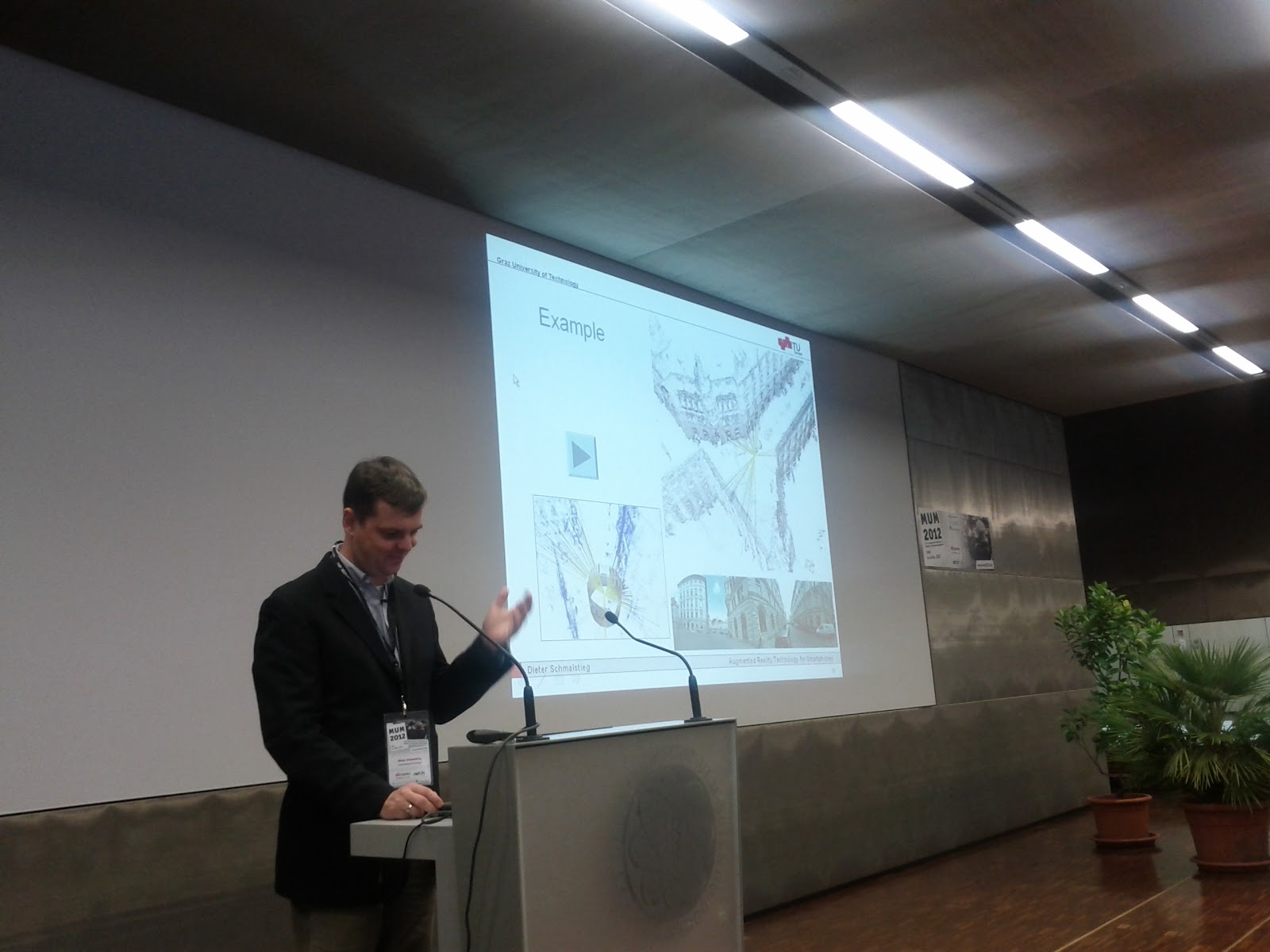
Dieter Schmalstieg opened the conference with his keynote Augmented Reality Technology for Smartphones. He nicely showed how this technology has evolved from expensive, bulky and immature platforms towards everyday AR in today's mobile phones. Ironically, though, all the AR systems of today (LayAR, Wikitude, Swisspeaks etc.) are simply based on compass and acceleration without taking any developments about visual and natural markers into account. Dieter showed some very impressive videos how AR experience can be improved significantly by stabilizing the digital overlays using markers extracted by image processing. Futhermore, he showed systems which could also recognize 'free space', e.g. blue sky, for placing digital overlays there instead of occluding important information from the real-world. Indeed fascinating was the presentation of the recording of a skate-board stunt which was recorded life, separated from the background and replayed and introduced as an AR layer in another setting over and over again.
While I was absolutely amazed about the technical achievements of AR research I'm still struggling with recognizing meaningful applications of this technologies. In the subsequent session Dieter mentioned replacing today's habit googeling for keywords on the mobile by instant web searches based on context and situations the users is in and pointing to: AR could replace the text-field of Google search...

I believe AR is a fascinating research area and also a great tool. Combining the advancements of visual markers/sensors/localization should help to make AR a useful and intuitive experience for accessing digital services in mobile user contexts.
Throughout the three days there was interesting work presented on novel design, mobile interaction, social interaction, security, mobile augmented reality, tools, audio, field studies, and public displays (see program). As part of these sessions I was presenting our work object circles which proposes to use the Google+ Circle concept for visualizing and managing data streams of smart items as an intuitive metaphor for everyday users. The underlying principle is to use the established interface of social media to also manage and interact with items and devices [1]. In addition to that, as part of the industry track, I presented our evaluation of the Dacuda scanmouse where could prove the more effective use of this device for everyday scanning tasks compared to multi-function printers, personal scanners, and mobile phone image taking [2]. Instead of a prototype I could actually show the working product which clearly showed to me the power of demonstrations. Let's see how many visitors will buy such a mouse;)
Finally, Flavius Kehr presented our field study on evaluating capturing of driving behavior via smart-phone vs. built-in fixed unit [3]. His statistical analysis showed that the fixed unit has more accuracy, however, the measurements of the phone are still significant to provide feedback to driver about his driving behaviour. Thus, Flavius could conclude with the clear finding that mobile devices are well suited to elicit driving behavior. This opens the space for many other players, e.g. insurance companies, to provide driving feedback in addition to the built-in systems of car manufacturers.

Nigel Davies provided the second keynote of the conference, he showed his passion about public displays as part of his involved into the PD-net project. He started off with the general benefits of giving a keynote: it allows you to present results without being bound to a strict scientific methodology. Despite the ubiquitous emergence of displays in public areas all these devices still suffer major short-comings: people feel disturbed by aggressive ads, the systems are passive and don't allow for interaction. There are much smarter ways of using these expensive installations: build toolkits to allow interactivity, implement context sensitive information, support audit-trails and hand-over for strolling users across several displays. Nigel also showed how ideas and concepts may quickly become obsolete: the idea of setting bluetooth-friendly usernames appears to be ridiculous today but seemed to be completely reasonable a few years ago [4].
As scenarios for more interactive displays he proposed emergency search for missing children, emergency announcements, behavior changes (e.g. collect vouchers by by-passing) and local marketing. Public displays should be open for users he concluded. Challenged by the question of why display providers would open up their systems Nigel responded with the proposal of radically re-thinking the concept of how displays are being used today: instead of catching eyballs based on impressions they would be more integrated into users needs. Nigel drew the analogy of Google embedding ads into search results rather than catching eyeballs on the front page. Whether the ad companies are already ready for this now is hard to say, Nigel admitted, but it would be worth trying.Public displays (sometimes also referred to as digital signage) is a growing field, a research community with its own conference has already been formed: The International Symposium on Pervasive Displays, 4-5 June, 2013 - Mountain View, California.

[1] Florian Michahelles, Philip Probst: Object Circles: Modeling physical objects as social relationships, Proceedings of the 10th ACM SIGMOBILE Conference on Mobile and Ubiquitous Multimedia (MUM'12), Ulm, Germany, December 2012 [PDF].
[2] Matthias Wyss, Alexander Ilic, Florian Michahelles: The scanner at your finger tips - analysis of the effectiveness of the scan mouse device, Proceedings of the 10th ACM SIGMOBILE Conference on Mobile and Ubiquitous Multimedia (MUM'12), Ulm, Germany, December 2012 [PDF].
[3] Driving Behavior Analysis with Smartphones: Insights from a Controlled Field Study, Johannes Paefgen, Flavius Kehr, Yudan Zhai, Florian Michahelles, Proceedings of the 10th ACM SIGMOBILE Conference on Mobile and Ubiquitous Multimedia (MUM'12), Ulm, Germany, December 2012 [PDF].
[4] Nigel Davies, Adrian Friday, Peter Newman, Sarah Rutlidge, and Oliver Storz. 2009. Using bluetooth device names to support interaction in smart environments. In Proceedings of the 7th international conference on Mobile systems, applications, and services (MobiSys '09). ACM, New York, NY, USA, 151-164.

Monday, December 3, 2012

Panel Discussion: "How do users find my app?"


Thanks to Lars Erik Holmquist from Yahoo Labs I had the opportunity to host a panel on “The curse of choice – how do users find your apps” at Siggraph Asia 2012. Together with my follow colleagues from previous Research in the Large workshop Henriette Cramer, FrankBentley and Niels Henze, and with Jaden Choi from TGrape we had an interesting discussion on apps. 

Nan Zhong, master student at ETH Zurich, opened the panel with a general introduction to the head and longtail nature of markets (slides). Head markets follow the so-called Pareto-principle which builds upon the fact that shelf space is usually limited, such that the merchant has to choose wisely which products to put on displays. The general rule is that only 20% out of all products generated a 80% of total revenue, thus niche products have a hard chance to appear on the shelf. Opposite to that are longtail markets which generated most of the revenue out of a huge variety of less popular niche products. However, this is only possible in digital markets were shelf-space is virtually unlimited and transaction costs of managing all these products can be kept low. Nan investigated [1] the nature of the Google Play market based on data-set of Appaware and – surprisingly – found: in contrast to most other digital markets (Netflix, amazon…), Google play is a clear Head market with even stronger characteristics than traditional retail. Thus, Nan’s conclusion was that developers should clearly focus on developing blockbuster. Furthermore, he found that the average capacity of users to install apps is limited by average to 40 apps. This means an app has to be really good in order to make it most user’s phone. What’s more, only 28% of all users would download not more than one paid app. Thus, free apps are much more likely to be successful. Furthermore, successful apps are rated better in general, whereas niche apps are used by expert users who are more critical give lower scores. Nan closed his talk with the suggestion to develop mechanisms that allow niche to be found more easily, as current collaborative filtering techniques would rather push successful apps even further.
Inspired by these insights we discussed various strategies of how developers could foster that their apps get found. Niels proposed to focus on search engine optimization by trying to understand how Google would rank apps. Thus, building up a history of a developer account releasing several successful apps overtime might help as well as tweaking the description of apps. Frank reported about his experience [2] of professionally marketing apps as any other product by approaching influential blogs launch posts that could trigger the demand for the app. Henriette proposed [4] to build upon the sharing friends by making apps social and allowing to be propagated by digital word of mouth.
We continued with the question of the price and Jaden Choi disclosed that he sees price rather following quality of the app. Price wouldn’t really matter so much, is rather a decision between paid and free app. Nan confirmed this finding saying that the 99cent price would be rather a relict of itunes than based on rational thinking. Also his research didn’t really reveal much experimentation of developers with adapting the price of apps. Jaden added that especially in Korea in-app payment for virtual gadgets would be strong opportunity and even more successful than having a paid app.
Niels disclosed his experience of releasing apps on Sunday [3] evening as the most effective measure getting users’ attention. Based on our experience with AppAware I mentioned that creating localized clones yourself from or own could be another approach to be found more easily in various languages and to get better positions in local app markets.
The fundamental question of developing interesting and new apps in the plethora of existing apps Frank answered by reverting on established methods of ethnography and experimentation. One approach would be to go out and observe users in order to get a glance what they might need. The next step then would be to “fail early”, meaning to release in short cycles and to learn from user comments to improve quickly.
Another interesting insight to me was that more expensive devices might also allow for more expensive apps. Finally, we had some controversy discussion about whether apps would prevail or rather be replaced by HTML5 web apps. The arguments by Frank (pro apps) and Niels (pro web-apps) where along the lines of barrier to install apps and technical flexibility of accessing hardware functions on the phone.
Overall, the panel together with about 50 visitors seemed to have been a good add-on at the Siggraph Asia conference. The App Symposium will be continued as a SiggraphMobile in 2013.
Additionally, Siggraph Asia was featuring an Emerging Technologies section. Different demos could be tried out proving new developments or also art and entertainment projects. My takes were controlling and seeing through a drone by a head-mounted display, “tasting” a website's ingredients (links, pics, bandwidth) as mixed liquor, an interface for controlling dancing robots, a force-sensitive display, an actuator game, and breath-awareness through a baloon.
Additionally, the Siggraph exhibition
featured a humanoid robot demo where a user's face gets project onto a mannequin representing a proxy of the user in meeting. <

Apart from that, Singapore is a fascinating place, an island of wealth, luxury, and strange rules in the heart of Asia. I really enjoyed the visit of the conference in Singapore. 

[1] Where should You Focus: Long Tail or Superstar?, An analysis of app adoption on the Android Market, Nan Zhong, Florian Michahelles. Symposium on Apps at Siggraph Asia, Singapore, November, 2012. [pdf] [slides]
[2] Frank Bentley, Santosh Basapur:   StoryPlace.Me: the path from studying elder communication to a public location-based video service, CHI EA '12, CHI '12 Extended Abstracts on Human Factors in Computing Systems, 2012 
[3] Niels Henze, Susanne Boll: Release Your App on Sunday Eve: Finding the Best Time to Deploy Apps (poster), Adjunct proceedings of MobileHCI, 2011
[4] Henriette Cramer, Mattias Rost, Lars Erik Holmquist (2011) Performing a Check-in: Emerging Practices, Norms and ‘Conflicts’ in Location-Sharing Using Foursquare. Proc. MobileHCI’11, Stockholm, Sweden. pdf