Showing posts with label nfc. Show all posts

Tuesday, April 23, 2013

A short report about NFC 2013

As program chairs Josef Langer and Tuomo Tuika opened the Fifth International Workshop on Near-field Communication (NFC2013) in Zurich on February 5, 2013. I as the general chair introduced briefly about the previous hype on NFC and it's current loss against national football conference on google trends.
The goal of the workshop was to bring together experts on RF and smartcards technology, security, NFC-related applications,
services and business processes. We received 22 research paper submissions around these topics. A rigorous review
process was followed with each paper receiving three reviews from international experts of the program committee. Based
upon this process, thirteen full papers were selected to appear in these proceedings and to be presented at the workshop. This
resulted in an acceptance rate of 59% for 2013.
The papers covered a range of topics related to NFC payment and ticketing, security, retail applications, and NFC communication. 

Marcello Morean started off with a secure solution for mobile ticketing.
Christian Saminger presented a solution of ticketing using the inverse reader mode where the  phone acts as reader/write device whereas terminal emulates the nfc ticketing card. This approach works on any nfc without requiring a secure element.
Next, Gerald Madlmayr talked about the nfc payment ecosystem.
Michael Roland presented on hacking and fixing relay attacks against the google wallet. Ali Alshehri explained how to analyse coupon protocols using the CASPER/FDR framework.

Marcello Morena stepped in for his colleagues and reported about user-centered design process of developing an NFC museum app.
Mark Lochrie showed how to use NFC/checkins to curate music preferences. By reusing library cards the music could be controlled.


Gregor Broll reported about on-going work of displaying sugar saturation in products using multimodal feedback. Maali Alabdulhafith reported about how to use NFC to check for drug allergies and notify doctors and pharmacists accordingly. The system relies on the hospital's database entries but may trigger some false alarms if the DB is not properly curated.

All papers are available in the online proceedings as part of the IEEE Xplore libary.

Overall, it was an exciting workshop. It remains to be seen whether 2013 will be the year of NFC, after all the previous years have been suspects of this event already;)

Monday, December 3, 2012

NFC Congress 2012

 It was the third time I attended the NFC Congress at FH Hagenberg. I was happy to meet so many people still believing in the opportunities of this technology even though actual deployment is still progressing slowly. I attended the congress one day before the announcement of Apple’s iphone, but there seemed to be pretty much consensus that Apple will not be a driver of this technology either.
 It was good to see how Nokia’s development of NFC finally got integrated into Microsoft’s Proximity API of Windows 8 which markets NFC as user experience instead of technical modes and parameters. However, the importance of windows mobile among Android and iOS still remains speculation. Payment is still seen as the main driver – or currently the main show stopper – of NFC. Several talks pointed out the roadmap for NFC as starting with wireless cards being rolled out mainly in eastern and southern Europe, next would be NFC stickers on phones, and finally the full integrated into the phone.
There the challenge will be to group service around payment such as coupons, loyalty, promotion, transport in order to incentivize consumers to switch from established payment methods – in Germany mainly cash – to mobile payments.
Finally, NFC was also proposed for micro-merchants as an alternative to transaction terminals, I enjoyed the split screen application for taxi-drivers presented by the Sparkassen Verlag Overall, the time horizon of greater adoption still remains unclear. Most participants, however, shared the believe that NFC would come sooner or later, mostly driven by the introduction of wireless cards which might be substituated by NFC later. Thus, I’m already looking forward to the NFC 2013 workshop which is technically co-sponsored by IEEE Switzerland Section and will take place in Zurich, Switzerland.

Tuesday, March 13, 2012

My picks from NFC2012


Together with Joseph Langer and Tuomo Tuikka I was involved in the organization of another issue of the NFC workshop series.
Jukka Riekki open the workshop by giving a keynote on NFC as an interaction method in interactive spaces. He showed various examples where the user interface is spread in the environment [1]. The challenge he outlined here is that the user first has to find the interface!
Accordingly, Jukka proposed a graphical language which would make the user aware of opportunities of interaction. He reported about studies with kindergarten children who learned reading the name tags by touching them with an NFC phone and listening to the audio voice [2]. His learning from that project was that the early simple NFC phones have the better usability: the reading zone of the antenna is more obvious and the phones are better to grasp.

Stefan Gruenberger from Hagenberg presented on the challenges of integrating NFC into existing electronic ticketing standards, such as VDV. Reading his paper [3] I got the impression that ticketing is a literal killer application by rather killing the application...

Michael Roland shared illuminating insights about the security challenges of emulating smartcards on smart phones. He reviewed [4] the various vendors' API's, such as JSR 177, Nokia's JSR extensions, Blackberry and Android. He concluded that the access to the smart card application via the various mobile phone operating systems should be better protected by additional user interaction, e.g. granting apps access to the payment function by entering a dedicated PIN. The implementation of this feature has to be moved beyond the operating system level down to the hardware level. Otherwise, relay attacks could make use of the GSM network to remotely access other user's secure elements to process payment without their notice.

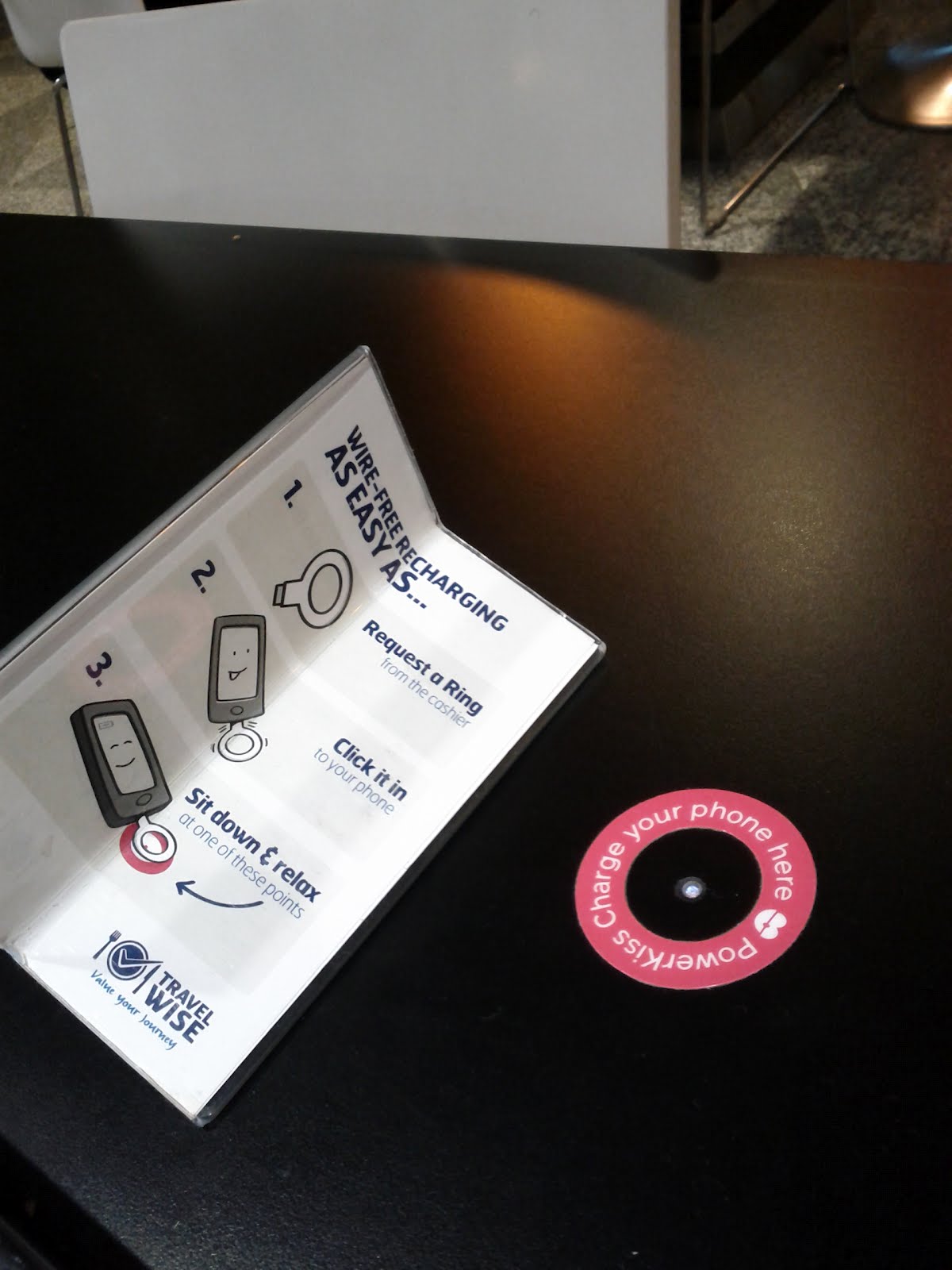
Esko Stroemer presented a new application for NFC, using the NFC standard for wirelessly charging devices. While he had to admit that powerage at the NFC frequency will be orders magnitude lower than standard wireless chargers (0.1 W in contrast to 5W), he presented convincing usage cases. erhaltladung, small devices, and finally the combination of NFC services and charging, as paid charging. Esko presented some prototype proving the concept. He outlined the design of RF systems that perform both at low coupling (standard NFC case) and high coupling (charging) as challenges. Later, at the airport I already saw a wireless charging station still requiring an external ring-antenna plug...

During the side discussions I learned that the NFC killer app payment is still hardest one due to the competing interest of the involved parties: the credit card issuers, such as mastercard/visa own the payment infrastructure in the stores. Unlike in the traditional cards business the user tokens are not owned by the issuers but by the handset manufacturers. Thus, this parties have to agree on the conditions. The implementations have to be at least as secure as the trusted card platform (which is hard to achieve in current implementations granting the mobile OS's direct access to the payment schemes as roland has pointed out). This process of consolidation might be still going for a while and then hopefully pave the ground for the flourishing user experience enhancing apps as Rukka has pointed.

The future of NFC is hard to predict, the future of the NFC workshop is rather clear: NFC2013 will be at ETH Zurich!
It will be exciting to see how NFC will develop and whether adoption will finally take off...CU in Zurich!!!

[1] Hosio S., Jurmu M., Kukka H., Riekki J. & Ojala T. (2010) Supporting distributed private and public user interfaces in urban environments Proc. 11th Workshop on Mobile Computing Systems and Applications (HotMobile 2010), Annapolis, MD, USA, 25-30.
[2] Riekki J, Cortés M, Hytönen M, Sánchez I & Korkeamäki R-L (2012) Touching Nametags with NFC Phones: a Playful Approach to Learning to Read. LNCS Transactions on Edutainment. Special Issue on Interactive Digital Storytelling,

Tuesday, February 14, 2012

LinkedIn as a new source for inside companies' facts?

The guessing about when and if at all NFC technology will ever have a break-through is still heavily discussed. Myself, I was very enthusiastic when several NFC plans got released and finally Google and Samsung brought the first NFC-enabled smart phone to the market. However, not much has happened since then, apart from NFC-payment trials, larger pilots and the Google wallet requiring Sprint subscribers having a bank account from CitiBank.
As company plans are secret, usually rumors and statements provide the basis for speculating on the future. I was very surprised to see a new source of speculating on company internals: the blog NFCtimes recently reported "LinkedIn pages for both von Behren and Wall indicate the pair left the wallet project last month." as a fact about Google Wallet.
Thus, be careful about changing your social media profiles, they might leak some company secrets and generate news...public is the new default!

Friday, July 1, 2011

1st Call For Papers for NFC 2012

NFC 2012 is the Fourth International Research Workshop with focus on Near Field Communication (NFC). This conference covers the entire technological area, beginning from RF and hardware, smartcards approach, security, applications and services, business processes, up to usability and user experience. NFC 2012 is ideal for addressing the challenges facing multidisciplinary research, development, design, and proof of concepts, pilot projects, deployment and fundamental limits of the NFC technology.

Date: March 13th, 2012 Location: Helsinki, Finland

NFC 2012 is technically co-sponsored by IEEE Finland Section

Selective Topics of Interest

RF & hardware related topics:
High-speed RF interfaces; Modulation techniques; Circuits and antenna design; Power aware design; Modelling and simulation; NFC tests & measurements; Protocol analyses and verification methods; Physical interfaces & architectures; Interoperability between NFC devices, tags and smartcards; RF system-on-chip designs; Wireless charging

Smartcards / SIM cards / Security:
Single wire protocol (SWP); Global platform; Multi-application platforms (SIM centric or not); Secure & multi-secure elements; Secure over the air (OTA) services; Security solutions for readers and terminals; System security solutions

Software platforms for NFC development:
Solutions with NFC add-ons and NFC stickers, software architectures; Smartphones and NFC for location based information services, NFC and augmented reality platforms, NFC m-payment and m-transfer architecture, Interaction systems in ubiquitous information systems; Interoperability between NFC applications and services

New applications & services:
NFC and social media (Facebook, Twitter...); NFC applications for consumers and citizens; Mobile value added services (VAS) using NFC; NFC ecosystems (e.g. tag management); NFC in business processes; Integration of NFC into “Internet Of Things” (IOT); Street and POS marketing with NFC; NFC services in education

Pilot projects, usability and user experience:
NFC and digital cities, airports, homes; Wellness; Homecare; Business usage & leisure activities; User interaction models for NFC applications; Acceptance of NFC devices and services; Field trials and pilots; Secure NFC ecosystem; Virtual ticketing and couponing with NFC, fidelization of NFC cards; User experiences of NFC applications

Important dates
  • 1st Call For Papers: July, 1st, 2011
  • Submission start date: September, 15th, 2011
  • Full Paper Submission Deadline: October, 28th, 2011
  • Author Notification: November 30th, 2011
  • Proceedings Version: December 16th, 2011
  • Author Registration: January 13th, 2012
  • Conference/Workshop: March 13th, 2012

Submission Guidelines and Publication
Authors are invited to submit research and application papers in IEEE Proceedings Manuscripts style (two columns, single-spaced, including figures and references, using 10pt fonts). The papers must not have more than 6 pages. Please use ONLY the following templates (for LaTeX or MS Word).

We appreciate the submission of academic workshop papers representing original, previously unpublished work. Submitted papers will be carefully evaluated based on originality, significance, technical soundness, and clarity of exposition. Duplicate submissions are not allowed. Therefore, submissions of work either submitted to, or already accepted or published in any other conferences/workshops/journals are rejected without reviews.

Registration
The link to our conference management system for registration and paper submission will be available on our website. The corresponding author must provide the following information: paper title, all authors’ names, affiliation and contact information, an abstract with about 200-250 words and about five keywords.
Submission of a paper implies that if the paper will be accepted, at least one of the authors must register for the workshop to present the paper. Otherwise the submitted paper will not be published.
Authors of accepted papers will receive guidelines in preparing and submitting the final manuscript together with the notification of acceptance.

Organization Committee
Josef Langer, Stefan Grünberger, Michael Roland, Christian Saminger, Upper Austria University of Applied Sciences
Tuomo Tuikka, Matti Penttilä, Erkki Siira, VTT Technical Research Centre of Finland
Florian Michahelles, Auto-ID Labs, ETH Zurich
Serge Miranda, University of Nice Sophia-Antipolis
Jari Hannuksela, University of Oulu, IEEE Finland Section

Website: nfc2012.vtt.fi For further questions please contact nfc2012@vtt.fi

Wednesday, November 3, 2010

Mobile Monday: Trends in Japan


I could attend the Mobile Monday in Zurich which had the topic Trends in Japan. Koji Fukada, President of YUMENI Inc., gave a tele-presentation live from Japan. He emphasized the importance of social networks on mobile networks, yielding fives times more users than accessing these services from desktop computers. I also liked the twitter-wallr being projected next to the slides where some people from audience did a pretty good job in posting summarizing life tweets of the talks...

Second Daniel Scuka, former editor of Mobikyo claimed in his talk that the mobile business success in Japan is not due to the unique user culture, instead it's the unique competitive culture in the business environment and regulatory regulations. The different carriers were competing not just on services but also using different communication technologies. This has fostered much more innovation than in Europe (see also here for details about this talk). I especially like table the showing "innovations" of the iphone having been released before.
Finally there was the talk of Jan Michael Hess, founder of MobileEconomy. He was reporting about the success of Felica and deriving lessons for Europe. He was a proclaiming Japan being six years ahead. However, what I didn't was the trick he was playing: taking the huge number of wireless payment and assuming that all of those would use this technology on their phones while there wireless cards being used in Japan as well.

Overall, I was pretty impressed from what we can learn from Japan. However, we also have to be careful to consider and understand ecosystem: I'm pretty convinced that the success of mobile internet in Japan largely depends also on the long commuting distances. Japanese often commute an hour and more to work using public transport where making calls is strongly forbidden. So, people have to do something else with their phones...gaming, web surfing, social networking.

Monday, August 30, 2010

NFC is back!?

I was just glad to see several reports praising the opportunities of NFC and documenting activities of several players that suddenly recognize NFC: the mobile network operators AT&T, Verizon and T-Mobile have started to test NFC according to Bloomberg, the online payments giant PayPal has partnered with Bling to implement payment, Facebook is experimenting with RFID according to AllFaceBook, Apple has hired an NFC expert and acquired several patents to implement NFC into the upcoming iphone 5 as TechCrunch reports, and new entrants as Google, Microsoft and others see NFC's advertising potential by linking a consumers' transaction history to their current location. Last but not least every "Nokia smartphone will have NFC, regardless of fact that the technology lacks a business model or any market demand", according to NFC World.

It would be great to deploy new consumer services current 1D-barcode applications are paving the road for and to revert on NFC which just provides a much better user experience than barcodes do [1]. Finally, we could move away from services where users deliberately have to scan items and arrive at services that push information to users once certain items enter the scanning range.

Back to the future of NFC - it has taken time, would be great to finally make it happen. Yet another step towards the internet of things for everybody...

[1] An Evaluation of Product Identification Techniques for Mobile Phones, F. von Reischach, F. Michahelles, D. Guinard, R. Adelmann, E. Fleisch, A. Schmidt, In Proceedings of the 12th IFIP TC13 Conference in Human-Computer Interaction (Interact'09), Sweden, August 2009, [PDF] [Talk]

Friday, September 18, 2009

Augmented reality vs. tagging

Just recently I stumbled over some exciting videos showing how augmented reality on mobile phones can be used to overlay the real-world with additional information when seeing it through the mobile:
new

end

This looks fascinating on the one hand as it finally runs on mobile phones today, but the idea itself is also kind of old on the other hand:
old:

end

I can imagine that applying AR may make sense in specific situations but how do indicate to you users that there is virtual information "behind" the current real-world view? How frustrating would it be running through a city watching it entirely through your mobile phone without finding any augmented information?
In that sense I still find the approach of tagging places with barcodes or NFC more convincing, e.g. as ServTag or several NFC projects show.

Friday, September 4, 2009

Interact 2009, Uppsala - Overall

As said in my first post, I found six sessions in parallel quite overwhelming. Thus, I - as all other visitors - only could attend a little fraction of the talks.

I enjoyed the contribution of Florian Alt who proposed a proxy-based implementation [1] to alter the content of website with or without the owners consent. This could increase usability of badly designed sites or, probably more important, to implement dynamic applications on static content, e.g. integrating infos from your social network with content of a website you're just looking at.

Next I fascinated by the simpled idea Paul Holleis [2] presented to attach a sequence of NFC tags behind a laptop screen in order to fascilitate touch-based interaction similar to a touch screen but at much lower cost. Obviously, one technically problem to be solved is to find screens that still allow the radio waves to permeate the screen.

Finally, I was glad to see the talk of Felix von Reischach [3], our Ph.D. student, presenting our work about the different ways of interacting with mobile devices and products: barcode vs. epc vs. nfc.


[1] F. Alt, A. Schmidt, R. Atterer, P. Holleis
Bringing Web 2.0 to the Old Web: A Platform for Parasitic Applications. Interact 2009. Uppsala, Sweden. 24-28 August 2009.
[2] Khoovirajsingh Seewoonauth, Enrico Rukzio, Robert Hardy and Paul Holleis. NFC-based Mobile Interactions with Direct-View Displays. Interact 2009. Uppsala, Sweden. 24-28 August 2009.
[3] F. von Reischach, F. Michahelles, D. Guinard, R. Adelmann, E. Fleisch, A. Schmidt: An Evaluation of Product Identification Techniques for Mobile Phones, Full Paper at the 12th IFIP TC13 Conference in Human-Computer Interaction (Interact2009), Sweden, August 2009, [PDF] [Talk].

Wednesday, April 8, 2009

Dissertation about NFC payment

Tom Wiechert finally had his disputation. He was analyzing the economics of contactless payments based on NFC. There, he compared the transaction costs and fees of various other payment systems (credit card, debit card, cash...) against NFC payment. Tom came up with a mathematical
model calculating different scenarios for retailers introducing NFC payment. His thesis [1] will be published soon on auto-id labs.org.
Throughout his thesis work he wrote an article [2] on the differences and communalities between EPC and NFC which got cited a quite bit, recently.

[1] (link to follow, search here)
[2] T. Wiechert, F. Thiesse, F. Michahelles, P. Schmitt, E. Fleisch: Connecting Mobile Phones to the Internet of Things: A Discussion of Compatibility Issues between EPC and NFC, Americas Conference on Information Systems (AMCIS), Keystone, Colorado, USA, 2007, [PDF].

Saturday, March 7, 2009

Talk "Mobile telephones as a consumer interface to services and applications" @ SEREC, ETH

I was invited at the symposium RFID visions and reality.
The session started with a policy overview from Florent Frederix of the European commision. Then I had the opportunity to talk about the specific features, building blocks, and challenges for developing successful applications for the mobile phone (slides here).

We had a quite extensive discussion about how to develop innovative applications (market pull vs. technology push), effect of free wireless access everywhere, and about the date when finally NFC will become available in Europe. I learned that the reason for adoption in Japan is that NTT Docomo just had the power to force device manufacturers to build it into the phone.
Another talk I enjoyed was about GPS and indoor positioning system, an interesting one was an inertial sensor system - not for planes - but for people in buildings. You find the program of the event here.

Thursday, December 18, 2008

User study: bar-code vs. epc-rfid vs. nfc

If you are an application designer concerned about which interaction modality (barcode/epc/nfc) consumers could favor most, have a look at this study we've just conducted lately: