Showing posts with label internet of things. Show all posts

Thursday, April 2, 2015

"Information is not knowledge. Knowledge is not wisdom. Wisdom is not truth."


Just recently I had the opportunity to attend the event Iot:: Empowering the Enterprise. The event was opened by a welcome note by Padmasree Warrior, CTO of CISCO, who predicted IoT as the next revolution of technology wave.
Then Wim Elfrink stepped onto the stage and started off that his kids would only have two statuses in life, asleep or alive. He questioned IoT being a hype and emphasized the fact that IoT could only be built in a joined effort. Furthermore he presented evidence that the selling of sensors would be exploding and sensors are being deployed everywhere. Only 1% is of our world today would be connected so far. He mentioned it would be less about the data more about how to transfer data to knowledge and wisdom. (Which reminded me after the famous Frank Zappa quote;) Surprising to me, Wim mentioned the public sector as the largest opportunity for sensors, he was calling for new governmental regulations to drive new opportunities. Finally, opened the stage for startup called relayr.io that provides connectivity to sensors bundled with an analytics platform.
Next on the agenda was panel discussion on the IoT eco-system. Debjit Mukerji from Siemens presented the notion of Web of Systems as an approach for moving from sensor-cloud analytics systems to decentralized, local information processing systems. Thus, IoT systems would not solely depend on connectivity to a cloud but could operate and reason locally in real time closer to the phenomenon. Debjit mentioned the importance of enterprises for startups to learn about industrial business cases, receive real-world feedback, access to testing resources and customers.
Amit Chaturvedy from Cisco Investments said the IoT would a global phenomenon wherof silicon valley startups would be mostly focusing on consumer applications, Germany would be leading in industrial developments, Asia about smart cities...different geographies would have different drivers.

From the startup pitches I recall pubnub allowing to connect devices in a secure manner, helium building networks on top of commercial wireless networks, edyn for monitoring plants (I can't help but hasn't Koubachi done than some time ago?), skyspecs making drones saving for industrial use, Ayla offering a network layer for remote monitoring, and placemeter quantifying the real world in real time using computer vision and video sensors.

VR Ferose from SAP sent out the message that connecting would be only the first step, the real value would be to learn from the data and most importantly provide enhanced customer experience. As an example he joked about settling down in the Bay area could be based on three apps google express, amazon prime and uber. IoT instead could go far beyond this experience provide new insights into predicitive maintenance and connected insurance. VR underlined his arguments by a remote control car demo where the premium rate has been adjusted to the driver's driving behavior. Personally, I was happy to see how earlier research [1] finally found its way into practice.
The last keynote on the program was delivered by Helmuth Ludwig who described integration of data during industrial manufacturing could be used the optimize performance and time to market. He mentioned the example of Omneo allowing to analyze events at real time. As you can't do physical prototypes for testing mars rover, simulation software can be used to eliminate prototypes, save resources, and increase efficiency. The future would rely on tools helping companies to produce in new ways, more efficiently and faster. For that reason, Siemens has opened its research lab in Berkeley to build bridges from the knowledge pool of universities and startups to the corporate world. As an example of this bridge he presented the video The Missing Link.

Overall, I enjoyed very much being at this event feeling the great passion for Internet of Things both in the corporate and the startup world. While I found a lot of belief that IoT will happen (e.g. presented by cisco), I still see more thoughts to be spend on innovative ideas about how IoT can really provide value across domains. Connecting millions, billions, trillions - whatever the large number should be - is just the first step. Just having access to more data does not really provide value in itself. 

How can we leverage these investments across completely different domains? How can a temperature sensors describe itself as a temperature sensor and team up with an air pressure close by to provide a more comprehensive picture and simultaneously calibrate itself using the data of another temperature sensor close by? Why would the owner of the temperature sensor allow access to his sensor, what could be an appropriate business model look like? How can we keep track of this connected layer, upgrade it and maintain it over time? How much can we achieve in the cloud, what do have to do locally, how can we transition effectively between cloud and edge?

To make IoT a reality in the enterprise there has to be more than collecting data, as Frank Zappa already recognized: "Information is not knowledge. Knowledge is not wisdom. Wisdom is not truth..." ;)

[1] Johannes Paefgen, Flavius Kehr, Yudan Zhai, Florian Michahelles: Driving Behavior Analysis with Smartphones: Insights from a Controlled Field Study, Proceedings of the 10th ACM SIGMOBILE Conference on Mobile and Ubiquitous Multimedia (MUM'12), Ulm, Germany, December 2012 [PDF].

Thursday, March 5, 2015

Summaries and Impressions: Internet of Things 2014 Conference, MIT, Oct 6-8, 2014

www.iot2014.orgIoT2014 is the continuation of IoT2008 (Zurich), IoT2010 (Tokyo), IoT2012 (Wuxi). This conference focuses on both academia and industry, it applies a rigorous review process to research papers (according to IEEE guidelines), features focused workshops on IoT subtopics as well as demo and poster session presenting early ideas.


The audience comprises a rather unique set of researchers, consultants, end-users, funding agency representatives and entrepreneurs.

Siemens’ Web of things research team has been the this year’s gold sponsor. This yielded an honorary mention of Siemens in the opening of the conference, a keynote speech (presented by K. Bettenhausen), sponsor booth and appearance on print material. Additionally, team members of WoT were visible beyond by organizing the web of things workshop and various talks.


The keynote of Kurt Bettenhausen (Siemens) highlighted the economic importance of manufacturing industry across the world. He expressed the need for innovation in order to keep up with the pace of innovation coming from China. Thus, in Germany the vision of Industrie 4.0 has been created which suggests products carrying all the data throughout the production process describing the steps for the product necessary to get produced. The driver for this vision are individual customer needs, dynamic design of engineer, new services, increased efficiency, and the importance of work-life balance of workers. After the lost battle in internet technologies, software and mobile services, it's the European industries' chance to make Industrie 4.0 a reality. This should allow companies to gain more flexibility in manufacturing control, reduction of energy and shorter time to market. In addition to the efforts and opportunities of big data analytics, there is much more knowledge available locally during the production process already which should be leveraged: why re-learning constraints from data analytics as they were already know during the design process. Questions from the audience focused on the performance of the Industrie 4.0 project progress in Germany and explicit examples of I4.0. The keynote speaker mentioned successful collaboration between research, industry and government but was not willing to disclose specific examples of I4.0.
David Clark (MIT) explained why the Internet has been so successful despite and because of the many design flaws and compromises. He started out with reflecting on the initial goals of the Internet back in 1975: development of a generic, global reaching, layered approach following network. In retrospect he admitted various flaws. Configuring wifi routers in today's home can be challenging as the design of the IP protocol would not care about configuration. Also the systems would neither know nor care what the user was doing and could not never tell if there was going something wrong. Furthermore, the Internet was never designed for mobility. Instead, the IP protocol was designed as a stupid network. As key learnings David derived,

If you build an ugly system, everybody says how ugly it is, if you build a well-defined system, nobody will ever look at it.
Thus, the consequences for today are that connectivity is not a cost issue anymore but configuration is. Initially the Internet has been designed to route packets, the rest was left up to the application, today the Internet is more about routing money, package routing is just a side-effect;)
An IoT panel discussion has been lead by Alex Ilic from the Auto-ID Labs. The keypoints raised by the panelists Sanjay Sarma (MIT), Elgar Fleisch (ETH Zurich/HSG) and Scott Jenson (Google) were interesting and diverse. The Internet of Things should develop successfully in specific verticals first and then only derive generic principles for cross domain platforms. This would counter the "European" approach of EU-funded projects which have spend time and money on developing bullet proof and shiny solutions which have a hard time of adoption in any domain. There was, however, no consensus which approach would succeed, at least the Internet has followed build-it/fix-it approach;). History of industry has shown that whenever a dominant design [1] has evolved, the industry became successful. For the IoT we are still missing this dominant design, who could lead this effort, IT players, or verticals? Finally, healthcare was mentioned to bear the greatest potential for IoT, as here it is not just about money but about a huge societal problem. Healthcare is so expensive today and differences between developed and developing world are tremendous. IoT would have the potential to link information and devices, provide access, empower people, drive costs, and challenge expensive equipment, e.g. MRI's, with simpler sensors embedded in connected billions of phones.
Shouman Datta (MIT) built upon the argument of the previous panel discussion that IoT should not be just about money but even more about societal challenges. The grand challenge would be to build a platform that creates an ecosystem for other to follow. The vision of the IoT would be rather old anyway. Shouman mentioned projects like 'pay per pee', monitoring at the toilet, odd projects like 'print your face' and others. The ultimate potential for IoT in healthcare will be to connect a plethora of dumb disconnected device of today, increase patient safety and increase building a more comprehensive understanding what's going in the human body for longer periods of time.
Overall, the IoT conference has been a very exciting event. It has provided the unique mixing researchers and practitioners which is hard to find. I'm very much looking forward to the 2015 edition in Korea: www.iot2015.org
[1] Mastering the Dynamics of Innovation, Utterback (1994) Harvard Business School Press ISBN 0-87584-342-5 Library call numbers HD58.8.U87 1994 658.4'06—dc20, p 24.

Wednesday, June 26, 2013

IoT has arrived in industry

Eight years from now I started with the Auto-ID Labs at ETH Zurich. Our mission statement has been "architecting the Internet of Things". The underlying principle was to build physical presences of physical objects, i.e. digital counterparts that would be linked to physical things through RFID, barcodes, or any other kinds of identifiers [1].
For specifying the architecture we investigated the application using RFID against anti-counterfeiting. We developed various mechanisms to verify the authenticity of a product based on its identifier, history of trace and physical fingerprints [2]. Simultaneously, we recognized the tremendous potential of not only linking supply-chain partners to the Internet of Things but to also develop new channels to consumers and to also captcollect crowd-sourced data from them [3]. While NFC technology has been not ready for this for a while we started with mobile barcode reader software first [4].
In addition to the Auto-ID Labs' research agenda of how to make things, products and objects part of the Internet, other communities, such as Web-of-Things researchers, have started exploring how to reuse existing web-standards, e.g. REST, or to expand to new standards, e.g. CoaP, in order to let addressing and communications with the Internet reaching out to more resource-constrained devices and sensors [5].
Meanwhile, governments (e.g. Germany and China) and industry have recognized the Internet of Things as a new paradigm for upgrading their sectors and products from mere physical objects to networked items coupled with services. Several terminologies, such as Industrial Internet [6], Internet of Things and Services, Social web of things, Internet of everything [7], describe attempts of occupying space in the emerging Internet of Things through proprietary and still mainly closed developments.
The success of the Internet was mainly based on the absence of interest of industrial partners in the early days, such that a few academics could set out the communication principles of TCP/IP which was designed to be open and flexible on future developments on the top in terms of new applications and from the bottom regarding new communication technologies and protocols.
The development of the Internet of Things, instead, is challenged various powerful players who aim at building their own platforms separat from others. Here, I believe in the evolution of developments as we could observe from the MNO's: today, all walled gardens have disappeared and mobile users can access the Internet regardless of their provider.
The power of the Internet of Things lies in the integration of information and sensor data of various sources, the re-use of the same sensor data for various applications, and the creativity of 3rd party developers as the app-store models have proven successful.
The Internet of Things has arrived in industry, I'm very excited about how the various players will manage their transformation from platform owner, hardware developers with long development cycles, and contracted partner networks to agile software developers that release beta-products and stay in a continuous dialogue with their customers.

At this point I'm very happy to hand-over the lead of the Auto-ID labs to Alexander Ilic. Alexander has a strong background in retail applications, investigating offerings of new services to retail clients via digital receipts (see cosibon). Simultaneously, I'm very happy for the opportunity to drive forward the development  of the Internet of Things in industry!

[1] D. Uckelmann, M. Harrison, & F. Michahelles(Eds.), Architecting the Internet of Things. Berlin, Germany: Springer. ISBN 978-3-642-19156-5
[2] Lehtonen, M.; Michahelles, F.; Fleisch, E. : Trust and Security in RFID-based Product Authentication Systems. IEEE Systems Journal, Special Issue on RFID Technology: Opportunities and Challenges, First Quarter of 2008.
[3] S. Karpischek, F. Michahelles, E. Fleisch, my2cents – enabling research on consumer-product interaction, to appear in Special Issue on "Smartphone Applications and Services for Pervasive Computing", Journal of Personal and Ubiquitous Computing - Springer, 2011, ISSN 1617-490,Doi: 10.1007/s00779-011-0426.
[4] F. von Reischach, S. Karpischek, R. Adelmann, F. Michahelles: Evaluation of 1D barcode scanning on mobile phones, Internet of Things 2010 Conference (IoT2010), Tokyo, Japan, November - December 2010


[5] Vlad Trifa, Dominique Guinard, Simon Mayer: Leveraging the Web for a Distributed Location-aware Infrastructure for the Real World.In: Erik Wilde, Cesare Pautasso (Eds.): REST: From Research to Practice. Springer, ISBN 978-1-4419-8302-2, pp. 381-400, New York, 2011
Peter C. Evans, Marco Annunziata: Industrial Internet, GE, Nov 26, 2012. [pdf]
[7] Dave Evans: The Internet of Everything, Whitepaper, Cisco, 2012.

Tuesday, April 23, 2013

Streetspotr - the mechanical turk in the wild

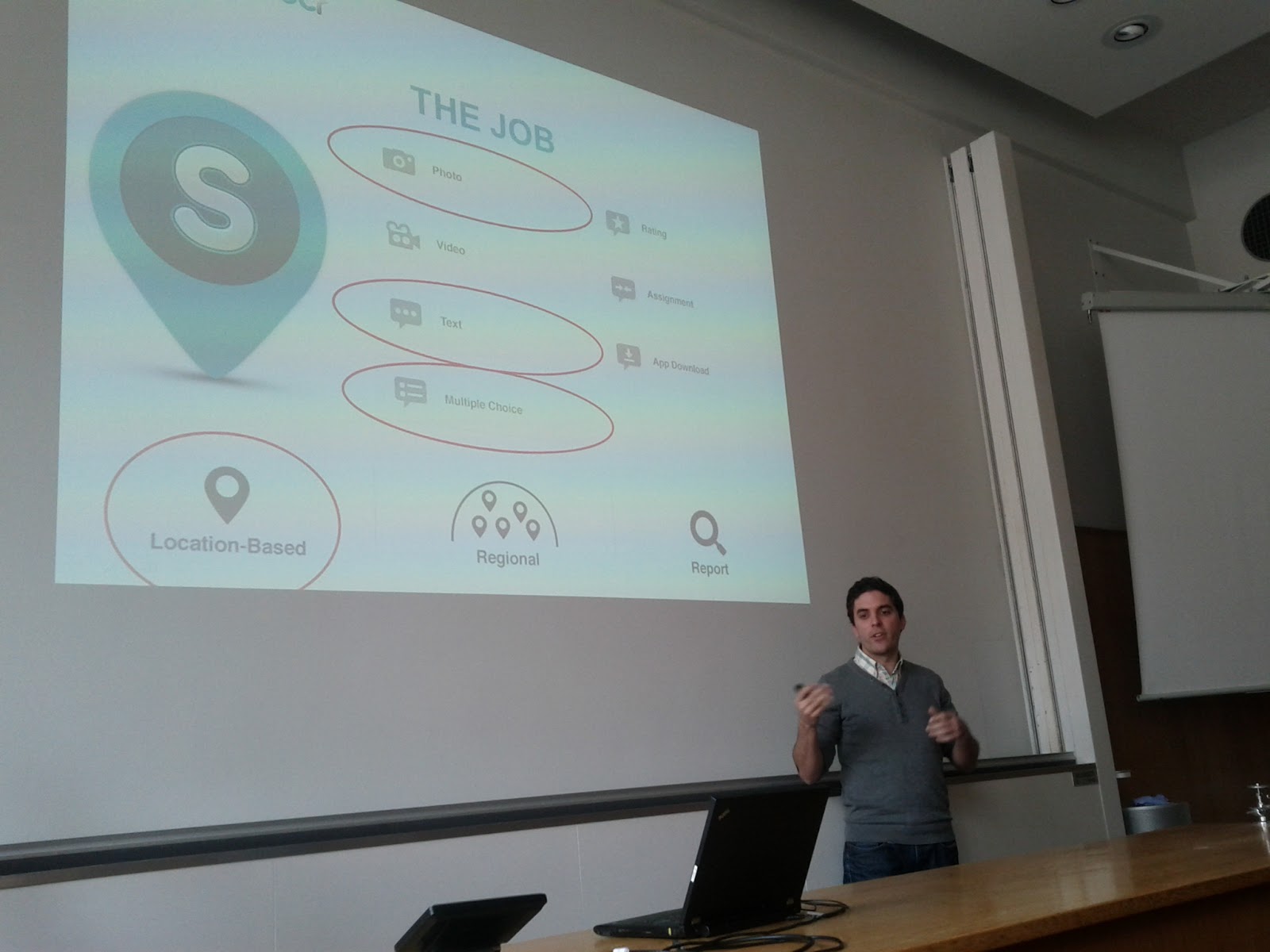
As part of my lecture Businees Aspects of the Internet of Things I could welcome Werner Hoier and Dorothea Utzt from Streetspotr.com as guest lecturers (slides).
They shared some interesting insights about their start-up which implements the idea of match-making between location-based micro-task issuing and fullfilling (as described earlier by [1]). Having reached out to 180k users who are only waiting for earning some fractions of a EURO by solving tasks like "take a picture of the menu in restaurant", "collect the GPS location of a parking lot", or "check the availability of an ATM". Without marketing but mostly relying on public media and blogs who featured their story they could build up their user base.
Interesting enough they are no longer looking for more users but rather for more job issuers. Also, so far they refrained from allowing to share user-to-user services. Their service nicely extends traditional services of market survey agencies. They reported about their most successful user who already earned a 600 EUR on their platform.

I'm really curious how this micro-task business evolves. I could well see opportunities for people waiting or being stuck somewhere and either earn money or giving something back by solving small little tasks in their downtime. Furthermore, finding a proper alignment between situation of the user and available tasks and corresponding rewards should be key to success, see also [2].

[1] Florian Alt, Alireza Sahami Shirazi, Albrecht Schmidt, Urs Kramer, and Zahid Nawaz. 2010. Location-based crowdsourcing: extending crowdsourcing to the real world. In Proceedings of the 6th Nordic Conference on Human-Computer Interaction: Extending Boundaries (NordiCHI '10). link
[2] Navkar Samdaria, Akhil Mathur, and Ravin Balakrishnan. 2012. Paying in kind for crowdsourced work in developing regions. In Proceedings of the 10th international conference on Pervasive Computing (Pervasive'12), Judy Kay, Paul Lukowicz, Hideyuki Tokuda, Patrick Olivier, and Antonio Krüger (Eds.). link

Wednesday, March 20, 2013

The German perspective of IoT: Industrie 4.0

Last year in June I had the opportunity to join a workshop on the impact of Internet of Things (IoT) for the German industry.
The consensus was that Germany missed the developed of an app-industry and hard-ware development. Instead, Germany should rather focus on proprietary platforms, appstores, for machines, cars and smart home: app-stores for things. A new job profile, the IoT-mechanic, is emerging.


The overall goal of  IoT is to improve quality of life, sustainability and growth (hm...isn't growth the opposite of sustainability!?). IoT bears the danger of forgetting the human yielding a rigid and process-oriented life focusing on the beauty, bold and technophiles.

Instead, developments should be driven by industry focusing on health, energy efficiency and standardization. Research questions could be:
  • how to integrate the diverse and isolated initiatives of IoT into one coherent platform?
  • IP doesn't work for everything, iterative processes based on specific examples should help to develop alternatives.
  • who owns the platform?
  • vertical platforms should be developed to solve societal challenges: production, plant manufacturing, and machine development
  • horizontal integration to reusing technology
    • interoperability
    • discovery/self-organisation
    • open platforms for third parties, SME's
    • reference architecture for niches
Involved parties should be telco providers, device manufacturers, service providers and end-users.
Overall, platforms should help SME's to develop new services and create business and jobs. Open-source should allow communities to develop new services. The german government should provide the legal framework to include various stakeholders, protect their investment, yield services for the good.
I'm looking forward to the results of Industrie 4.0.

Tuesday, November 6, 2012

Internet of Things 2012 in Wuxi


As a program co-chair I had the opportunity to visit the recent IoT conference hosted by Fudan University in Wuxi.
Elgar Fleisch opened IoT2012 by reviewing the potential of IoT to add things-generated data to the gulf of human-generated data. He listed standards, biz models, ownership management, and human behavior change as future research topics within the IoT domain.
Li-rong Zheng, general chair IoT2012, thanked the various organizers and conference chairs. Then, Junyu Wang reflected on the importance of Wuxi as the center of IoT in China walked through the program. A rigor selection of papers yielded an acceptance rate of only 24.7%.
Finally, I had the pleasure to introduce Stefan Ferber from Bosch who is not only a professional but also passionate private user of IoT technology (see his smart home here). In his opening keynote of IoT2012
Stefan Ferber (see his slides) introduced to various  IoT projects going on within Bosch and reflected on the significant differences between old and new economy in terms of organization structure, decision processes and effectiveness. He showed how technology finally helped to disrupt established hierarchies allowing for more flexible and dynamic patterns of collaboration. By refering to Conway's law ("organizations which design systems ... are constrained to produce designs which are copies of the communication structures of these organizations") he underlined the importance of changing organizations correspondingly along the technological innovations.

 
Stefan used the very strong metaphor colliding galaxies to express the impact of IoT to organizations. He introduced the geigermaps project as an example of how a grassroot movement of people connecting their sensors to each other can provide a much faster and more fine-graine picture on radiation than the official authorities could or wanted to provide during the Fukushima accident. As a second example of grassroot movement he refered to the iot bill of rights signed during the open iot assembly by various stakeholders of IoT as a free movement of concerned individuals outside regulatory bodies.
Stefan went on reflecting on the properties of IoT-enabled products. Originally, purposeful systems were handled and controlled by their owners: the owner was responsible, the producer only provided the tool. However, once the tool becomes smart this might change: the tool's functionality grows outside its original physical purpose and follows the digital configuration the producer has set-up. Thus, the producer becomes responsible as well (see also his blog post on his talk).


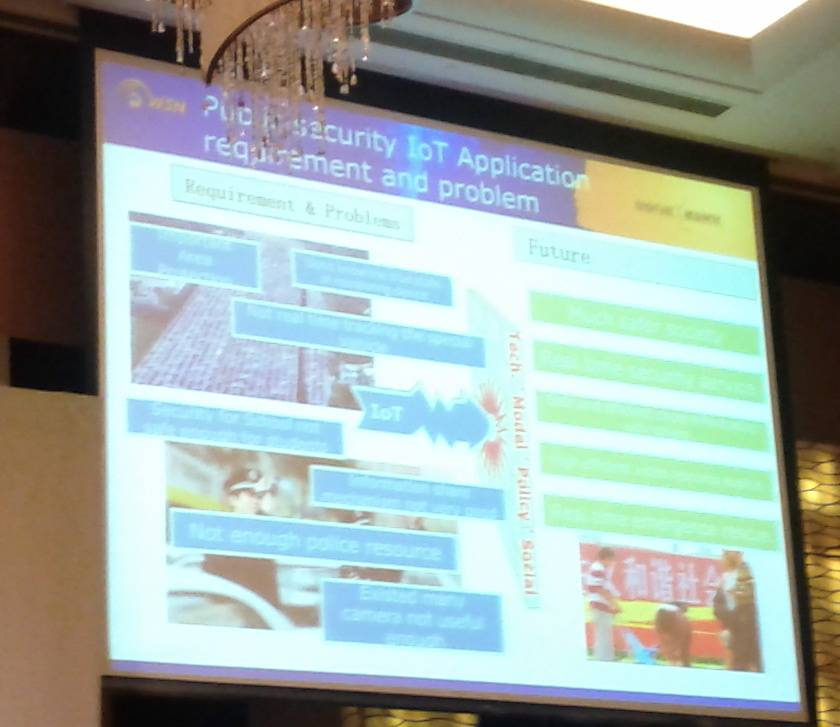
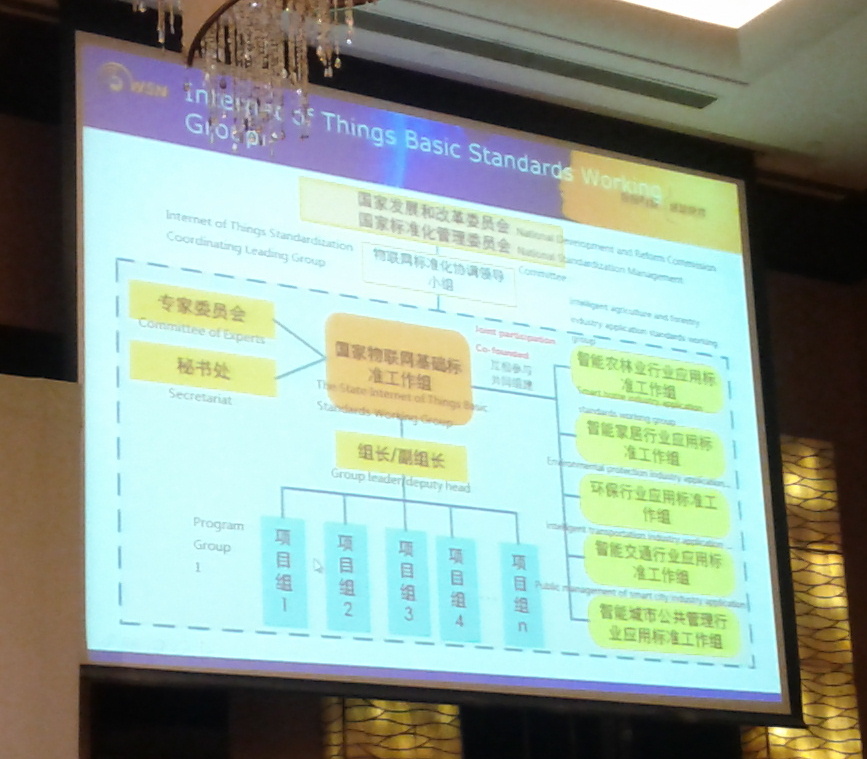
Haitao Liu, Wuxi SensingNet Industrialization Research Institute talked about  IoT projects in China which focus on standardization and  applications, such as resolving traffic jams, better public transportation and parking guide systems. As part of public security initiatives he mentioned the "Golden Shield Project" which aims at improving communication of security data and management of capturing technology as cameras in public areas. He also mentioned smart homes as an emerging trend in China which would pose challenges of integration and interoperability. There would be also several activities of environment monitoring where single measurements stations are being gradually replaced by swarms of collective pollution meters. Furthermore, IoT projects in China would also focus improving efficiency of agriculture and food safety.

Overall, it became pretty obvious that IoT in China clearly relies on central power and control leveraging the the central governance system. I'm pretty sure that sooner or later this approach will collide with the rather distributed technical nature of IoT. Mr. Liu concluded his talk by referring to the current bottlenecks of limited understanding of requirements, insufficient standards and prevailing information silos. He mentioned IoT as a big market for Chinese companies for transiting from traditional manufacturing to highter value IT businesses. The Chinese government sees IoT as new enginge to accelerate the development of Smart City construction for upgrading the industrialization in China.

Then the technical program started, the proceedings can be found here. Overall, the conference had about 300 visitors. According to comments I received from visitors the mix between large variety of  scientific and industrial workshops, demos and posters was highly appreciated.
Finally, the show goes on in 2014: see you all at IoT2014 hosted by Prof. Sanjay Sarma at MIT.

Friday, October 5, 2012

Semiotics and Internet of Things

I first had to find out about Semiotics before I could participate in the Panel on "Semiotics and Informatics: Syntax, Semantics and Pragmatics of Knowledge Management in a Social Context" at IC3K'12 conference in Barcelona.
I was really curious about how semiotics - studying about properties and functions of sign - could be applied to guide interpretation of phenomena in context. Kecheng Liu illustrated how different semiosis between system user and system analysist can create a gap of understanding which may cause many IT projects to fail.
In my contribution I proposed to apply Semiotics for interpreting things as parts of situations and contexts of use. Furthermore, by analyzing available Master Data of products Semiotics could help to derive possible uses of objects which could instruct robots about how to use those - as an alternative to ontologies.
Finally, in I used the opportunity in my keynote to draw the attention of knowledge management to thing-generation data (in addition to people-generated they work on today).


Thursday, September 27, 2012

RobIoT @PICNIC12 - when robots meet IoT

Organizing RobIoT at Pic-Nic 2012 provided me the opportunity to visit the Pic-Nic Festival for a first time. It took place in the Eye in Amsterdam. I was asking continuously but apparently it is hard to say who the audience of this conference is: it is not really business, not really academia, it is more about hackers and artists presenting work to people from creative media.

Before our workshop started I could attend an opening talk of George Dyson who gave a fantastic talk about the history of IT and the continuous battle of good vs. evil in research, as IT in a way was also part of the development of the nuclear bomb. Byron Reese gave a rather frantic talk about how IT and media has freed our lifes from pre-defined marriages/jobs/hobbies/styles. I liked this introduction but was a bit disappointed about the following yes-we-can gobbledygook, such as technology would keep our society alive and his rather cynical finding of "hunger is just a technological problem".
Rich Pell from the Center for Postnatural History talked about life which was less natural but more cultural. He called intentionally altering of biological life as animal hacking. He emphasized how cooperations as Syngenta etc. would secure their gene-modified seeds: through obscurity, terminator gene preventing an organism from reproduction, and a non-breeding agreement preventing the farmer from breeding seeds through a legal contract becoming effecting after the seeds' bag has been opened...

Additionally, I could also visit some interesting Demos such as Mobile Thrill which provides experience to your mobile phone: you place your phone on a conveyor build with video switched on, the phone disappears and comes back with its "impressions". Additionally, I also liked the mobile bench.


Rob van Kranenburg opened RobIoT by predicting the advent of robots in our daily lifes anytime soon. Thus, instead of building nightmarish scenarios of mean robots taking over the world, he proposed thinking more proactively about how we can turn robots into something useful and joyful as the topic for this one day workshop. How can we fuel thr vision of robots and Internet of things with positive scenarios?
Gerald Santucci was talking about future robots as easily programmable devices that will empower people to write apps for them the way they do with PCs and smart phones.
Alessandro Bassi compared Asimov's Laws of Robots with the “IoT laws” of Adam Greenfield. He also reminded us that Asimov's Laws, e.g. "A robot may not injure a human being", are not obeyed if we look at the drones killing people in Middle East.
Stefan Gessler gave an overview on the variety of robots of today starting from the dumb vacuum cleaner robot to the humanoid robot. How was elaborating on how to link robots and proposed IoT as a technology for reducing costs for letting also robots communicate.
Karmen Franinovic talked about active material as the basis for activating things. I liked her more integrated perspective of making things active themselves instead of only having robots as separated mediators for actions.
Heico Sandee talked about how robots can give hands to the internet and how active actuators could "actify" passive objects. In order to make that happen research would have to focus on representing, exporting, discovering, executing and matching robot capabilities to real-world tasks and needs.
Finally, I talked about how robots could provide the arms and legs for the Internet of Things. I proposed to start with an initial set of basic activities robots could provide, such as moving or searching things. Then, from those basic activities atomic  tasks as press/touch/carry/etc. should be derived. Additionally, infrastructure requirements such as localization, hand-over to robots should be solved. And finally, robots should be integrated with Internet of Things, e.g. deriving object use from barcode master data.


In the very active discussion with our roughly 40 participants I learned that it probably will not be so so much about robots but rather about actuated materials as pointed out by Karmen. Concerning tasks it may more about tasks humans do not want do, e.g. ironing/car-driving. However, this of course highly depends on personally preferences, too. Robots may also used in combination with persuasive technologies to persuade human users to achieve a personally set goal.
There were also critical comments about why we would only think of privileged situations. Are there other cases, too. Or robots the machine staff of the rich? Are disabled not interesting when it comes to business cases?
Also, some participants mentioned that actuation to a large extend might not be really so much different from screens when it comes to present information or notify the user in more subtle ways (e.g. tapping on ones shoulder).
We also had some good discussion about what we do not want robots to do, what about taking care of your kids? Could robots allow you to work more, which counters of Karl Marx' initial idea of robots allowing you actually to work less.
We discussed whether DIY-robots would be necessary to spark innovation. Certaintly, DIY robots prove the state of maturity of a technology. We even had a moving plant-robot in the workshop which was build for less then 5 EUR...
And finally the discussion closed with questions about responsibility of robots, whether it would be the user, owner or manufacturer, what about garage doors killing people?
I see robots as an emerging topic to be considered with in IoT, see also here [1,2].

[1] Kevin Ashton: Humanizing Robots, RFID Journal, September, 2012.
[2] F. Michahelles, Rob van Kranenburg and Markus Waibel : Enlisting Robots - Once robots are integrated into the Internet of Things, they can perform tasks automatically., Inside the labs column in RFID Journal, August, 2012.