Throughout the lecture I considered the activation of students in the lecture as an insightful element for establishing sharing of knowledge in class among students and lecturer. In the final feedback and evaluation session of my class I was intrigued about one student's comment: "Actually, in the beginning it was quite hard. As students we never get asked about our opinion, I first had to get used to have an opinion..." - looks like the experiment was worth it!
Monday, June 11, 2012
Students' opinions about business aspects of the Internet of Things
Throughout the lecture I considered the activation of students in the lecture as an insightful element for establishing sharing of knowledge in class among students and lecturer. In the final feedback and evaluation session of my class I was intrigued about one student's comment: "Actually, in the beginning it was quite hard. As students we never get asked about our opinion, I first had to get used to have an opinion..." - looks like the experiment was worth it!
Friday, June 8, 2012
Science Magazin article about IoT in China
Mara Hvistendahl has released an article on the current state of Internet of Things research in China in the recent issue of the Science Magazin. She describes how the Chinese prime minister has been pushing Internet of Things as one of the key technology areas for transforming the Chinese industries.
Several researchers from China mention the opportunities in food monitoring and challenges of IoT such as standardization, big data analysis, and establishment of decentralized systems. I contributed my doubts about how an emerging Internet of Things - building upon the notion of sharing and collaboration - could be successfully implemented in an environment still fostering central control. Additionally, I expressed my admiration about the large sensing projects becoming possible in China at much faster pace than in Europe or US. I'm looking forward to discuss my observations at Internet of Things China 2012 Conference in a few weeks.
Friday, May 11, 2012
How the IoT might affect the Insurance business
I've been invited as a keynote speaker of the ICIS Usergroup Konferenz in Karlsruhe. The ICIS Usergroup
is a network various insurers and solution providers that develop an inventory management framework for insurers across various sectors. The ICIS represents the business logic for all core functionalities of insurers including claims management, CRM, bonuses of the sales force etc. The systems has been initially implemented on Oracle, after 15yrs the system is being opened up now to run also on DB2 as well as being available as a web-service based platform on various browsers. Current plans moving forward include the integration of social networks in order to capture a more comprehensive view on the insurances' clients interacting with the insurance also via Twitter and Facebook.
In my talk I provided a description of the emerging Internet of Things in order to picture new opportunitities and challenges of capturing new dimensions of data about real world phenomena. I presented an outlook of future services insurances could be provided and also reflected on to which extend social media could start replicating the old notion of social circles being liable for each other without requiring a third-party insurance.
I'm looking to the first insurance services being tied and sold as a new feature of actual physical products.
is a network various insurers and solution providers that develop an inventory management framework for insurers across various sectors. The ICIS represents the business logic for all core functionalities of insurers including claims management, CRM, bonuses of the sales force etc. The systems has been initially implemented on Oracle, after 15yrs the system is being opened up now to run also on DB2 as well as being available as a web-service based platform on various browsers. Current plans moving forward include the integration of social networks in order to capture a more comprehensive view on the insurances' clients interacting with the insurance also via Twitter and Facebook.
In my talk I provided a description of the emerging Internet of Things in order to picture new opportunitities and challenges of capturing new dimensions of data about real world phenomena. I presented an outlook of future services insurances could be provided and also reflected on to which extend social media could start replicating the old notion of social circles being liable for each other without requiring a third-party insurance.
I'm looking to the first insurance services being tied and sold as a new feature of actual physical products.
Labels:
insurance,
internet of things,
keynote,
social media
Thursday, April 26, 2012
Towards an Internet of Actions
Denis Harscoat from DidThis visited our lab for another time to talk about quantified self (slides) and an emerging Internet of Action in my lecture. Denis started off with rather broad insights about our evolution. The adaption of genes to our environment takes more than 10.000 years, so humans learned to short-cut by developing culture, habit and practices (e.g. we wear coats in winter time). However, culture change is still slow, thus, we are interested in best practices. Now, instead of relying thoughts, beliefs and preferences, self-tracking technologies empower a "data-driven life".Thus, Denis wants to establish an Internet of Actions where the community can propose practices and routines which can be picked up by others. Users can promote actions on DidThis. An example is PlankADay which appears to be a very effective exercise. DidThis collects the adoption of this activity by other users and provides insights into the uptake. DidThis could institutions and organizations to promote activities people could benefit from.
I'm looking forward to the data-driven life gaining traction on DidThis.
Wednesday, March 21, 2012
How to retrieve data about users' apps
As I mentioned already earlier this year, AppAware is gaining momentum now by new features and functionalities. Apart from the new website, the latest release has been an API which for the first time also allows other developers to include AppAware data into their apps and websites (e.g. see pic to the right).
Upon registering an app from the AppAware DB can be obtained
- list of top android applications characterized by
- users' install/update/removal events, furthermore aggregations of popular and trending apps can be delivered, finally top of apps can be also retrieved by country.
- time frame (hour/day/week/month)
- app category (out of the 31 google app categories)
- app details for a specific package_name
- name/url/description/market_url/developer_url/developer_email/rating/number_ratings/version/category/size/downloads/likes
- the AppAware user for profile (provided a OAuth2 access token has been granted from a user to your application)
- id/username/bio/user_url/picture/device/apps_count/likes_count
- list of applications with details installed by a user (again OAuth2 access token is required)
Tuesday, March 13, 2012
My picks from NFC2012

Together with Joseph Langer and Tuomo Tuikka I was involved in the organization of another issue of the NFC workshop series.
Jukka Riekki open the workshop by giving a keynote on NFC as an interaction method in interactive spaces. He showed various examples where the user interface is spread in the environment [1]. The challenge he outlined here is that the user first has to find the interface!
Accordingly, Jukka proposed a graphical language which would make the user aware of opportunities of interaction. He reported about studies with kindergarten children who learned reading the name tags by touching them with an NFC phone and listening to the audio voice [2]. His learning from that project was that the early simple NFC phones have the better usability: the reading zone of the antenna is more obvious and the phones are better to grasp.
Stefan Gruenberger from Hagenberg presented on the challenges of integrating NFC into existing electronic ticketing standards, such as VDV. Reading his paper [3] I got the impression that ticketing is a literal killer application by rather killing the applicatio
n...Michael Roland shared illuminating insights about the security challenges of emulating smartcards on smart phones. He reviewed [4] the various vendors' API's, such as JSR 177, Nokia's JSR extensions, Blackberry and Android. He concluded that the access to the smart card application via the various mobile phone operating systems should be better protected by additional user interaction, e.g. granting apps access to the payment function by entering a dedicated PIN. The implementation of this feature has to be moved beyond the operating system level down to the hardware level. Otherwise, relay attacks could make use of the GSM network to remotely access other user's secure elements to process payment without their notice.
Esko Stroemer presented a new application for NFC, using the NFC standard for wirelessly charging devices. While he had to admit that powerage at the NFC frequency will be orders magnitude lower than standard
wireless chargers (0.1 W in contrast to 5W), he presented convincing usage cases. erhaltladung, small devices, and finally the combi
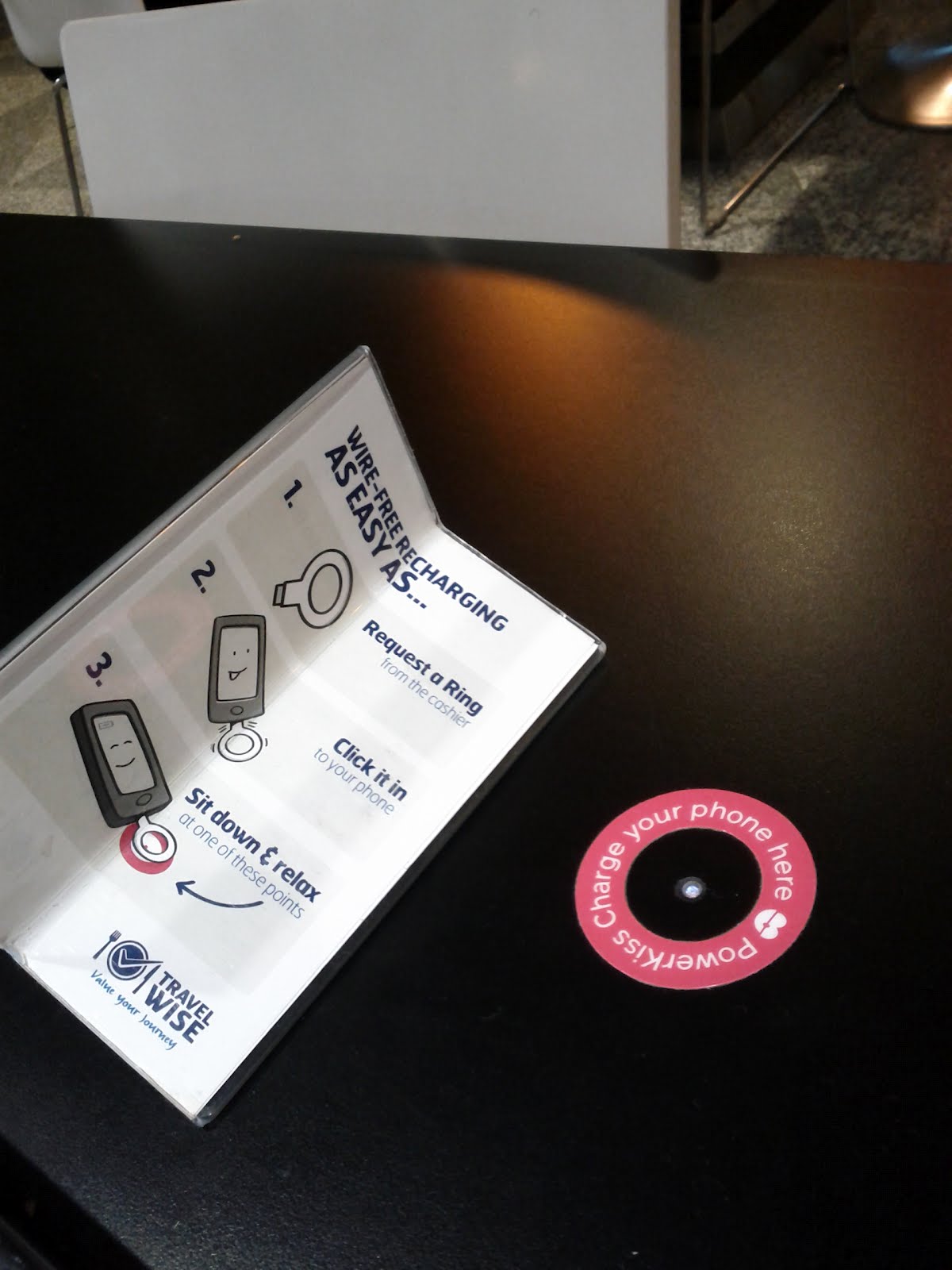
nation of NFC services and charging, as paid charging. Esko presented some prototype proving the concept. He outlined the design of RF systems that perform both at low coupling (standard NFC case) and high coupling (charging) as challenges. Later, at the airport I already saw a wireless charging station still requiring an external ring-antenna plug...During the side discussions I learned that the NFC killer app payment is still hardest one due to the competing interest of the involved parties: the credit card issuers, such as mastercard/visa own the payment infrastructure in th
e stores. Unlike in the traditional cards business the user tokens are not owned by the issuers but by the handset manufacturers. Thus, this parties have to agree on the conditions. The implementations have to be at least as secure as the trusted card platform (which is hard to achieve in current implementations granting the mobile OS's direct access to the payment schemes as roland has pointed out). This process of consolidation might be still going for a while and then hopefully pave the ground for the flourishing user experience enhancing apps as Rukka has pointed.The future of NFC is hard to predict, the future of the NFC workshop is rather clear: NFC2013 will be at ETH Zurich!
It will be exciting to see how NFC will develop and whether adoption will finally take off...CU in Zurich!!!
[1] Hosio S., Jurmu M., Kukka H., Riekki J. & Ojala T. (2010) Supporting distributed private and public user interfaces in urban environments Proc. 11th Workshop on Mobile Computing Systems and Applications (HotMobile 2010), Annapolis, MD, USA, 25-30.
[2] Riekki J, Cortés M, Hytönen M, Sánchez I & Korkeamäki R-L (2012) Touching Nametags with NFC Phones: a Playful Approach to Learning to Read. LNCS Transactions on Edutainment. Special Issue on Interactive Digital Storytelling,
Tuesday, February 14, 2012
LinkedIn as a new source for inside companies' facts?
The guessing about when and if at all NFC technology will ever have a break-through is still heavily discussed. Myself, I was very enthusiastic when several NFC plans got released and finally Google and Samsung brought the first NFC-enabled smart phone to the market. However, not much has happened since then, apart from NFC-payment trials, larger pilots and the Google wallet requiring Sprint subscribers having a bank account from CitiBank.
As company plans are secret, usually rumors and statements provide the basis for speculating on the future. I was very surprised to see a new source of speculating on company internals: the blog NFCtimes recently reported "LinkedIn pages for both von Behren and Wall indicate the pair left the wallet project last month." as a fact about Google Wallet.
Thus, be careful about changing your social media profiles, they might leak some company secrets and generate news...public is the new default!
As company plans are secret, usually rumors and statements provide the basis for speculating on the future. I was very surprised to see a new source of speculating on company internals: the blog NFCtimes recently reported "LinkedIn pages for both von Behren and Wall indicate the pair left the wallet project last month." as a fact about Google Wallet.
Thus, be careful about changing your social media profiles, they might leak some company secrets and generate news...public is the new default!
Subscribe to:
Posts (Atom)