Showing posts with label china. Show all posts
Showing posts with label china. Show all posts
Friday, June 8, 2012
Science Magazin article about IoT in China
Mara Hvistendahl has released an article on the current state of Internet of Things research in China in the recent issue of the Science Magazin. She describes how the Chinese prime minister has been pushing Internet of Things as one of the key technology areas for transforming the Chinese industries.
Several researchers from China mention the opportunities in food monitoring and challenges of IoT such as standardization, big data analysis, and establishment of decentralized systems. I contributed my doubts about how an emerging Internet of Things - building upon the notion of sharing and collaboration - could be successfully implemented in an environment still fostering central control. Additionally, I expressed my admiration about the large sensing projects becoming possible in China at much faster pace than in Europe or US. I'm looking forward to discuss my observations at Internet of Things China 2012 Conference in a few weeks.


Wednesday, June 22, 2011
IoT in China revisited: centralized views and smart cities are taking off

 Again, I had the chance to attend the IoT Conference organized by Shanghai International Exhibition in China, a continuation of the series started in 2010. The audience included about 400 participants from business all over China. I contrast to last year, about half of the speakers were international.
 The session started with welcome notes from various honorable people, such as Wang Lie from CCPIT Shanghai promoting trade, Wang Xi from Shanghai Institute of Microsystems, Shuguang Liu from IOTCC, a newly founded body to coordinate between enterprises and government funding, and An Xiaoping from MIIT (ministry of industry and information technology). All speakers emphasized the business opportunities of IoT as being huge for the future in China.
Chenghai Zhang, a  former leader of the post telecommunication ministry, went even more in detail in his very energetic presentation (so energetic that the translator faded out from time to time) and proposed IoT as a way for recovering from the economic crisis, a new technical revolution. He mentioned the capabilities of IoT to broaden the access to economy for new users, to transform the Chinese industry from manufacturing into providing higher value services, and to extend today's value chains by new business concepts.
After that opening,  some leaders were called to the stage to trigger short demos featuring NFC, fingerprint, 2D-reader, LBS and RFID technology – exposing those is the core building blocks of an emerging Chinese IoT.
The conference was opened with the first keynote by Ed Schuster from MIT. He started with a quote from Ian Waitz which d escribed that MIT during its 150 years of existence had built infrastructure the first 75 years, and had created industry the second 75 years. Thus, the next 75 years should be devoted for applying this knowledge to build a better planet. Ed gave some examples semantic information processing as part of his work within the data center[1]. I think this perspective of big data [2] should be further investigated as part of Internet of Things research.
 by a talk about smart cities by Bin Cao from Datang Telecom, a telecom equipment manufacturer. He again emphasized the view of extending IoT to all industries in China in order to collect, network and communicate even more information within China. As the main challenge of cities in China today he mentioned one-time funding during construction without sufficient budget of maintenance. Furthermore, planning divisions have to improve collaboration, development should be better identified, standards should be enforced, and finally processes should be designed to allow for more sustainability.
As a specific example Bin Cao presented a centralized control system for cities where "efficient modules" collect data and provide services to the citizens. I challenged his assumption of “identifying people’s needs and providing services accordingly” by proposing to follow open data policies for empowering individuals and business to provide services in addition to centralized authoritive units in order to allow for more diverse and competition among services.
In my talk (slides) I proposed to go beyond IoT in supply-chains and seeking
 for opportunities of accessing tacit knowledge of people and individuals. I gave examples of my2cents and appaware as opportunities of new services based on user-generated content. While user-generated content is probably not at the core of IoT, I see the IoT as an important enabler for developing new services including user input.
Later, Paul Havinga presented a nice definition of IoT:
Everything is networked; Smart objects and global connectivity allows for open multi-purpose services.
Thus, IP cannot be solution, not even the low-power versions as 6LoWPAN as  being too expensive and too complex for cheap and small devices. Instead, he proposed the integration of various technologies coupled with embedded intelligence as a way for establishing distributed collaboration. The IoT would allow to collect information and to make information available right at where the action is.
Finally, IoT-A hosted a Session and provided an update of its activities.
The second day was opened by Prof. Hao Min who presented several projects of Anti-Counterfeiting. He mentioned tagging of Wulangje liquor which I already reported about here (link) . Alan Thorne from the Cambridge Lab reported about several activities at the Cambridge lab concering discovery services and applications in airline industry.
Prof. Wei Zhao from University of Macau, leader of the 973 IoT project, mentioned the inauguration of IoT colleges. As core topics he proposed computer science, software architectures and sensors. He explained the IoT as being built upon sensing, generating virtual measures, and dealing with the challenge of fusion of data. As a main challenge he put identification of objects.He was elaborating on how identifying. While I agree on this challenge, I also think that progress has been made when thinking of all the different numbering schemes that already exist in industry. As the history of the Auto-ID center has shown, posing a new global numbering fails. Instead, building upon and fusing established schemes is the way to go.
Toru Murase from Sumitomo Electric industries was proposing FTTH as a backbone of running an Internet of Things in the home, mobility network.
Jin Mitsugi was talking about an Internet of Consumer Electronics. For this he introduced a dual interface RFID tag developed by Keio and Fudan Auto-ID Lab allowing to read an RFID tag both from an RFID reader. Thus a newly developed data XML can be read from http, apps, and through a gateteway from home network appliances. They have installed the system in 49 consumer devices so far for monitoring the energy consumption [3]. In combination with IR-sensors counting people, consumer devices could be switched off.
Daeyoung Kim took his inspiration from H ollywood movies, such as minority report and motivated the need of software infrastructure by new verions of facebook/twitter/google for objects. ID-based network with thing’s application level protocol “id- based network for Internet of things”. He mentioned lightweigth Ipv6, 6lowpan and RoL as common alternatives and then introduced SNAIL allowing for mobility management security and routing.
Finally, smart cities was discussed as a hot topic for IoT. Ono Mitsutoshi from Kashima Consulting focused on the development process of smart cities, Yokoi Masaki from Nomura Research envisioned several IoT apps for citizens in smart cities. He proposed that China should understand what smart city means for China of just copy-paste-ing from US. As layers he outlined network layer, platform layer for recognition/identification/authentification, and the application layer for apps.
Michael Zhang from Shanghai Youth Info-tech was talkbing about making life bet ter. He focused on the example of Pudong Xinqu area, the neighborhood of Shanghai where most multi-nationals and expatriates reside. He presented a credit-card combined with access functionality to private spaces. A house-keeper application allows for convenience services implement in a cloud: you can virtually queue in line of hospitals, such that you can wait from home. Also, you can shop from remote, obtain registrations, e.g. dog permit, and banking. Whereas in this app is reasonable in the current context, I was wondering why not also working on changing procedures and introducing planning to get rid of queues.
My take-aways:
- IoT is proposed as a way out of China’s disappearing business case: low manufacturing costs are disappearing due to increasing salaries and the currency under pressure adjusting the low peg to US dollar. Ways have to be found to transform industry to go beyond manufacturing and provide more valuable services higher up in the value chain.
- Still a very centralized view: During the conference it was mentioned several times that building the IoT would allow to collect and share data within China more efficiently. International collaboration was never really mentioned other than learning and adopting from others in order to follow the national agenda.
- More concerns about information security than privacy: Throughout the discussions I experienced that fear about external forces/attacks is more established than protection privacy. The notion of control is more severe than establishing an environment of diversity and creativity. This contradicts quite a bit with the notion of IoT from Council which sees governments getting more and more challenged by an IoT, where individuals and groups gain more power due to open pools of data knowledge (OpenData).
- Smart city is the major topic for Iot in China: Smart cities is a major topic in China. As part of the global trend of people moving towards cities, the mega-cities, compact spaces where millions of people live and work, are happening in Asia. Thus, city governments are facing tremendous challenges of providing public infrastructure and services. Information and sensing technologies will become important. Making sense out of this data and connecting all the emerging systems is where IoT comes into play. Finally, construction industries always share close relations to public and governmental funds, thus smart cities fit right into "thinking big".
- IoT drives economy in China at least until 2012: I met several Chinese funding agencies promoting IoT for industry. However, as a new president is going to be elected in 2012 it's not yet clear whether he will put the same emphasis on IoT as Hu Jintao does today. Thus, organizing our IoT2012 Conference in Shanghai/Wuxi in November 2012 should be the right moment.
[2] Big Data: The next frontier for innovation, competition, and productivity, McKinsey Global Institute, May 2011
[3] Katumasa Ihara, Goshi Kojima, Tomonori Kondo, Yuki Sato, Hisakazu Hada, Jin Mitsugi, “Home energy consumption suppression using EPC enabled multi-vendor consumer electronics control”, IEICE Technical Report USN2011-7 (2011-5), pp.29-37
[4] Sungmin Hong, Daeyoung Kim, Minkeun Ha, Sungho Bae, Sangjun Park, Wooyoung Jung, and Jae-eon Kim, "SNAIL: An IP-based Wireless Sensor Network Approach Toward the Internet of Things," IEEE Wireless Communications, 17(6):34-42, Dec. 2010.
Thursday, November 25, 2010
Internet of Things: first, there have to be plans…

 GIOTC (see for pictures) brought me to Beijing. Compared to Shanghai (I visited earlier this year) Beijing feels much more relaxed, less high-rise, wider spread, less crowed and by far older. The conference took place just next
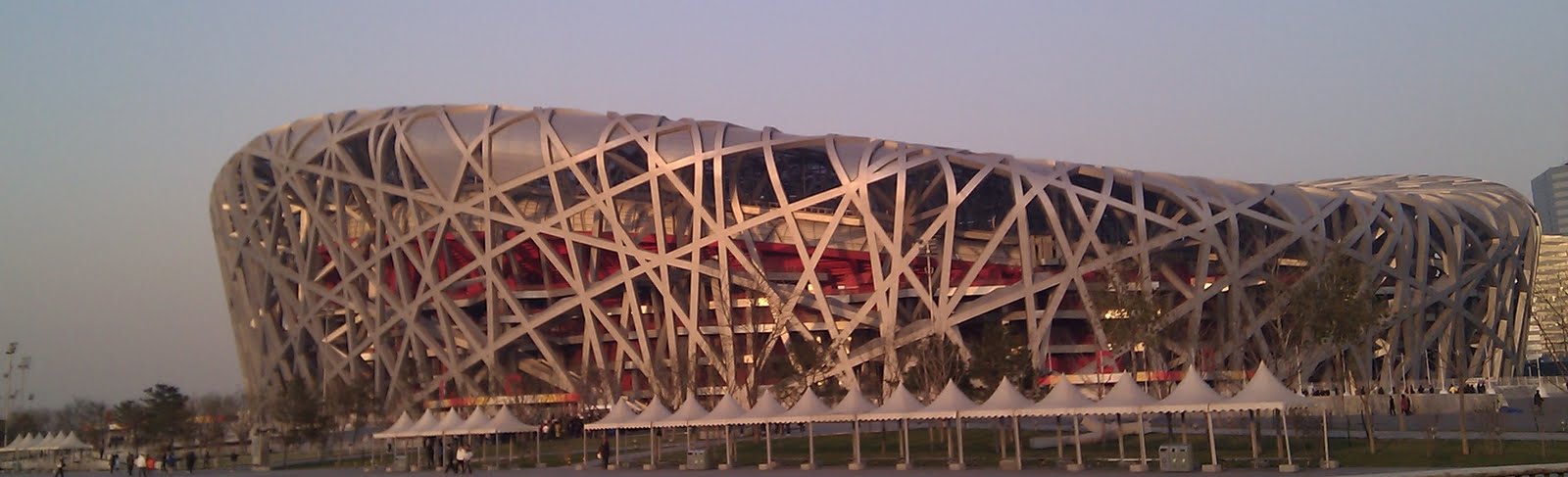 to the remarkable buildings from Olympia 2008.
 Zhong Qi, chairman of the Chinese RFID alliance open the conference by emphasizing the importance of the internet of things as a vehicle for growth after financial crisis. As the US have promoted Smart Earth, Europe the IoT development plan [1], South-Korea the u-Korea initiative [2] and Japan the i-Japan program [3], the prime minister of China has identified the Internet of Things as one of the seven key technologies for China. China can build upon
  the Golden Card project [4], which involves the 940 million ID cards, 2.7 billion banking cards, health insurance cards which adds up to a total of 7 billion RFID-based smart cards in China and
  suddenly put China 3rd after US and UK. China strongly believes in developing their own technologies and standards while simultaneously recognizing openness and international cooperation as key parameters to success. According to Qi, the growth rate of RFID in China was at 35% throughout the last years.
Florent Frederix from the European Commission motivated the Internet of Things with the on-going trends of miniaturization, mobility, pervasiveness and sensors. He referred to the work being conducted in the funded iot-research cluster focusing on logistics, supply-chain, retail, green buildings, green car s and ehealth. As a counterpart to China’s 12 year development plan he outlined the EU’s IoT action plan [1] which defines governance, privacy, silence of chips, security, standards, public private partnerships, smart cities, informed consumers and IT waste as major steps to be worked on.
Philip Cousin presented the EU-China expert group as a first attempt to exchange ideas on architectures, naming concepts and protocols in EU and China. Zou Liu from the Ministry of Communications, Science and Technology and Gao Yanjie from the Ministry of Health reported about achievements and goals in their divisions. It would have been really interesting to learn more specifics about their learnings and their pilots they have performed.
David Boswarthick from ETSI instead mentioning specific business cases or scenari os motivated the emergence of the IoT by the saturation of mobile market (as everybody already has at least one cell phone…), the opportunity of not networked 50-70 billion machines, and the emerging legislation demanding smart systems. He described the development of the Internet of Things as a step-by-step development process which should be also replicated in the corresponding standardization efforts. The requirements of the ETSI platfo
 rm he outlined as a technology-agnostic multi-purpose service platform providing machine to machine services in an end-to-end fashion while re-using existing standards.
Liu Jianming from the national power provider State Grid impressed me with the astonishing number of 1.6 million employees in his company. Kang Lee from NIST presented the standardization activities in RFID and sensors networks from the US perspective. Wu Donya from CESI promoted OID as China’s open numbering scheme, frankly, looking quite similar to the EPC framework. It's rather questionable how this (old) approach could successfully build upon old legacy [5] being designed for unix machines instead of resource-constrained RFID tags.
Finally, I could talk (slides) about the importance of not limiting the IoT to business corporations but to include the consumer and to provide service for the everyday use. I gave some examples of our work about my2cents.mobi and codecheck.info and Product Empire. In various discussion I later had offline I was confronted with questions about how brand owners would react about bad comments on their products being spammed by fake users of their competitors. I was told several times that our approach might work in Europe but not in the harsh environment of China where competitors might try everything for fighting each other.
It was very refreshing when Michael Dohler from World Sensing challenged the unbe lievable numbers of business research agencies creating hypes and heating up markets. He specifically took the example of 7 trillion networked devices (see how this wrong number travels the world, 140k hits on google!) predicted by WWRF for 2017, which would mean about 10.000 nodes per square meter on earth… He mentioned that the technologies for IoT are basically there, the tricky part would be the optimization for data rate, range and power consumption. He proposed to break up
 with the old thinking of separated communication layers but to design for bi-directional communication instead: "I talk to my sensors, the sensors can also talk to me.". Finally, he disclosed his approach of not only selling components but bundling them with services and then co-leveraging with big players. Big players, he mentioned IBM, are already established in the market and speak the language of the clients, nobody is interested in sensor data…
In the final panel discussion of day one about future perspectives an d challenges, both Chinese and European participants either referred to expert groups or to work reports which would provide the answers soon. While in Europe the funding schemes of the European Commission are remarkable (just outreached by the vast amounts of funding the 14 ministries bear in China!), for natural and sustainable growth in our economies we still need to watch out for real problems and pains which are not found in the scenarios use case sections of work reports...
Next day, Girgio Priester from the Smart Cities initiative motivated the need cities to invest into infrastructure, human capital and, additionally, also in new technologies. H e reported about the municipal wi-fi mashup in Barcelona which provides municipal workers (police, inspectors, social workers) with communication. He also mentioned networked parking meters, public lighting optimization and informative panels. This would all sum up in savings of 400kEur/year. Venice was another example. There, a multi-purpose smartcard would allow to use transport, bicycles, museum entries for 90.000 residents and 22 million visitors. The vision is to apply dynamic pricing to distribute the tourists more efficiently over the year. It was not quite clear how this RFID pilot on the old continent does really link to Internet of Things.
Prof.Sangchan Park from Kyung Hee University really contrasted these pilot with not just one but 2 0 "u-city"'s currently being build in Korea aiming at public services, eco-friendly areas, and promoting u-city as a new lifestyle of the future. While all projects are very much technology-driven the extend, pace, and size is really breath-taking (e.g. Songdo).
Alvaro de Oliveira from living labs in Europe summarized on real-life test and experimentation environments in Europe where users and producers co-create innovations. Living Labs have been characterised by the European Commission as Public-Private-People Partnerships (PPPP) for user-driven open innovation, but not going much beyond pilots.
I perceived it a little foolish when the successes of the future cities and living labs in Europe were praised as IoT success stories. Compared to the mega project in Asia (which yet have to prove their success not to become another Masdar!) they are, if at all, first seeds of the beginning of networked RFID (see also another comment here).
Ramjee P rasad, Devasis Bandyopahdyay, Geir Koien and presented about security and privacy. The tradeoffs between security and comfort, the long-term perspective of privacy, and also the dynamics changing notions of privacy. Looking at the younger generation today: what George Orwell was afraid of the big brother could watch, the digital natives voluntarily shout to cyberspace without any purpose...
Usman Haque from Pachube called for a very pragmatic approach of deriving standards: forming them through gr adual implementation. He proposed to be as flexible as you can, make as simple as possible to share data, to include context, to support multiple protocols & adapters, to not sumarize data, but to maintain single points, to help individuals manage data, and to
help companies, cities to provide service. He summarized that as extreme data sharing. He sees the role of pachube to "pipes for the internet of things" and to reduce friction to build things for others. He bases his business models on high volume service that pay, while the masses could use this service for free. After his talk, he just disappeared in the crowd of people asking for his business card.
Zhang Jianning from Z-Park was talking about the success of virtual good sellers in China and reminded the audience to thoroughly seek to understand the internet of things and not just running along the hypecycle.
Chen Xianxing from LSD Science and Technology was just going in this direction by pretty directly promoting his company's wireless devices as well suited for the Internet of Things.
Peng Haixing from Huawei reported about the importance of the IoT from the perspective of network solutions provider.
The final panel discussion concluded that IoT would be more succesful in Europe and Asia due to the strong believe in infrastructure there. I would call this rather sellfish, at least there was no representative from the US participating in this panel. Jusgt to mention that it was the Auto-ID Center at MIT coining the term Internet of Things (see here), it were the giants wallmart and DoD deploying RFID, just look at RFIDJournal for the latest stories. But indeed, I don't see the the big funding schemes for IoT either. Perhaps it's more about top-down (Europe and Asia) or bottom up (USA), e.g. IBM's smarter planet is right on track.
Overall, GIOTC has been a very exciting event for again feeling the power and ent husiasm in China for the Internet of Things. Due to China's scale and its long-term perspective of plans combined with the pace and the once-decided-irreversible-will to implement we could expect large scale IoT implementations, not just pilots, very soon. Whether this will be successfull has yet to be found out.Thus, China should be an exciting environment to work in for the upcoming years.
I was also very happy to feel the spirit of the crazy IoT gang, Rob van Kranenburg, Usman Haque and Mischa Dohler. To be continued!
[1] Commission of the European Communities (2009-06-18). "Internet of Things — An action plan for Europe"
[2] u-Korea Masterplan, 2006
[3] i-Japan Strategy 2015, 2010
[5] X.660 : Information technology - Open Systems Interconnection - Procedures for the operation of OSI Registration Authorities: General procedures and top arcs of the ASN.1 Object Identifier tree (link)
Sunday, June 27, 2010
China: Internet + Internet of Things = Wisdom of the Earth
 The IOT
 EXPO, the 3rd conference for telecommunication dedicated to Internet of Things, gave me the opportunity to visit Shanghai. I was very amazed about the strong motivation for Internet of Things in China. Several talks mentioned the opportunities for network carries and solution providers for implementing better services and solving society problems. I learned that the entire hype for Internet of Things has actuall
 y been jump started by the current premier minister Wen Jiab
 ao mentioning Internet of Things as one of the key industry areas for China. In accordance to that, the chinese government decided that the city of Wuxi should be premier place for IoT in China: every year the lpolluted ake of the city could not provide drinkable water anymore, until the local government has installed a huge sen
 sor network – the national government was so excited that Wuxi is now the home of internet of things in China. Furthermore, the local party leader had the ambition to attract in the next 5 years 30 talents and entrepreneurs, which coined the 530 plan, This plan supports start-ups in Wuxi, e.g. with free office space.
Backed by this political order various company leaders discussed the opportunities of RFID and sensor networks. In my first talk I took the opportunity to reflect on the history of the Internet of Things strongly emphasized that IoT goes far beyond RFID and has to focus on citizens and consumers and not companies and commercial businesses only. In my second talk I presented a number citizen IoT examples of our current research in Zurich.
 Later, I also could visit the Auto-ID Lab of Hao Min at Fudan Universit
 y. I pretty astonished about his company Quanray. Besides the development of chip design for EPC UHF Gen 2, which is applied to Liquor bottles preventing counterfeit and as well as for ticketing featuring 64kbit of memory. The most stunning development, however, was the integration of NFC into a SIM card: As the SIM is owned by the TelCo’s the get into the position of offering NFC payment services now including over-the-air configuration (OTA) without depending on the hesitating handset manufacturers. In orde
 r to get the signal out of the SIM which is usually shielded by the battery, Quanray’s RFID sticker which is powered by the external reader amplifies the SIM’s NFC signal and load-modulates it to the reader. Thus, all smart phones could turn in to NFC phones soon, Even if this just happens which the major TelCo in China, this already targets 500 millions of consumers...
Overall, Shanghai is really a very exciting fast changing place...I went to a restaurant with fishes swimming inside the table.


Subscribe to:
Posts (Atom)