The guessing about when and if at all NFC technology will ever have a break-through is still heavily discussed. Myself, I was very enthusiastic when several NFC plans got released and finally Google and Samsung brought the first NFC-enabled smart phone to the market. However, not much has happened since then, apart from NFC-payment trials, larger pilots and the Google wallet requiring Sprint subscribers having a bank account from CitiBank.
As company plans are secret, usually rumors and statements provide the basis for speculating on the future. I was very surprised to see a new source of speculating on company internals: the blog NFCtimes recently reported "LinkedIn pages for both von Behren and Wall indicate the pair left the wallet project last month." as a fact about Google Wallet.
Thus, be careful about changing your social media profiles, they might leak some company secrets and generate news...public is the new default!
Tuesday, February 14, 2012


Thursday, January 12, 2012
AppAware powered by 42matters: from research to business practice
 In 2010 Andrea Girardello presented AppAware for the first time at MobileHCI 2010 [1]. The idea of logging mobile installations on one's Android phone and share it with others was well received but kind of hard to sell to the research community. Thus, the next step was to evaluate and prove that by measuring app installations we actually could get more precise quality information about the long-tail of apps than the Android market provides by user reviews [2].
 Driven by the idea of research in the large (see also other's experience here [3]), several ideas of predicting successful apps, applying recommendation systems, and learning app usage in the wild emerged but could never pursued as a research project: the continuous user growth (from 30k to 100k) pulled down our server, AppAware had to move to the cloud and emails flooded Andrea's inbox when the service was not available.
Struggling with how-does-all-this-maintenance-related-to-a-PhD and how-do-fund-this-project a decision was made: Andrea Girardello, Andreas Budde, Ivan Delchev and Bo Wang founded 42matters AG.
Focus on publications and research questions was substituted by the driving thrill of user growth and business exploitation. Together with Dani Arielli the old app has been completely re-designed and learning and sharing about apps with friends has become the new focus (download here).
Today, the endless nights of development and hard work have been rewarded by "The best business ideas" award of Venture.
The ceremony was opened by a keynote of Peter Brabek-Lemathe, chairman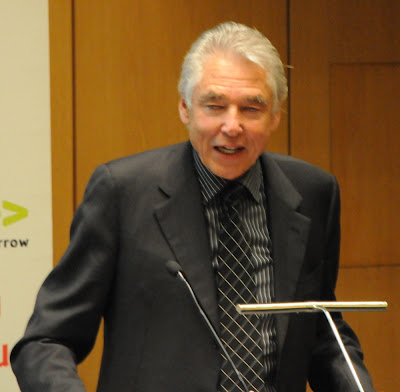 of Nestle. He gave some advice to the young entrepreneurs: understand societal trends, envision what consumers will want, think global straight-away, innovate and renovate your products every year, stop thinking you can do it yourself, and be competitive within your team or throw a stone.
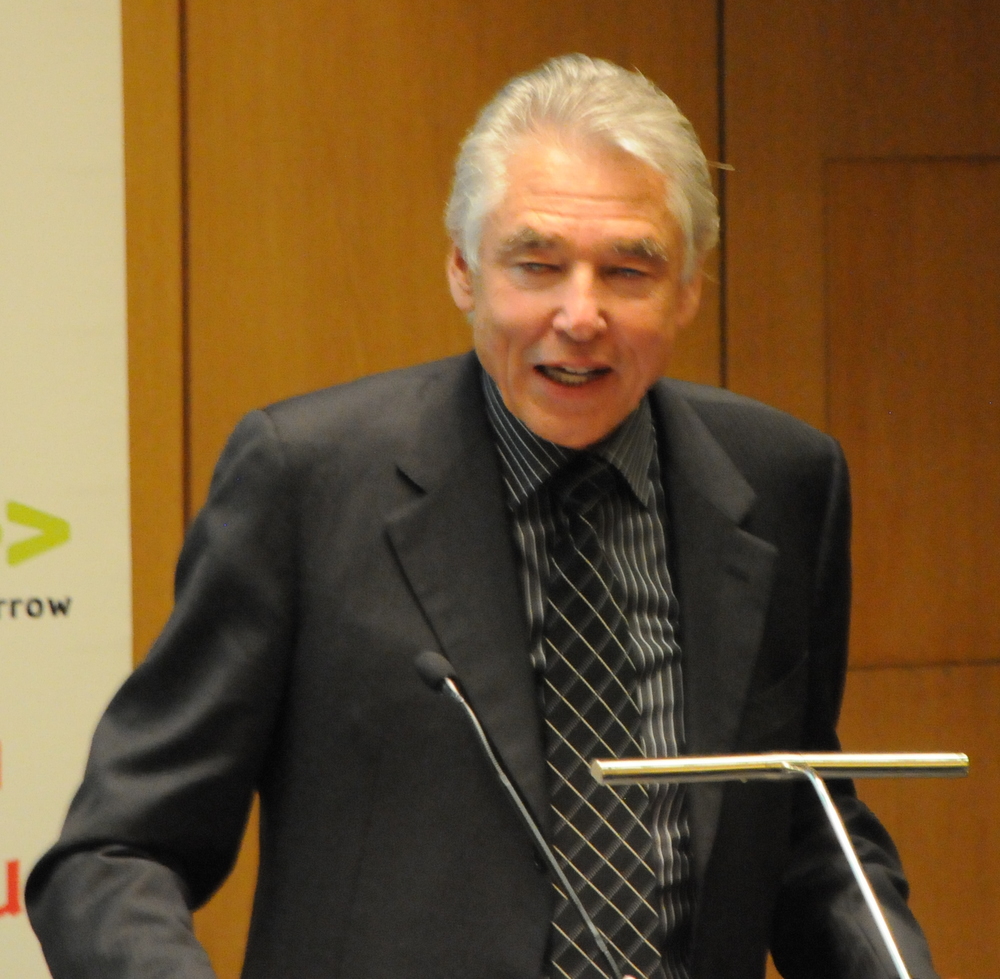 of Nestle. He gave some advice to the young entrepreneurs: understand societal trends, envision what consumers will want, think global straight-away, innovate and renovate your products every year, stop thinking you can do it yourself, and be competitive within your team or throw a stone.
Good luck to 42matters AG, Android users unite on AppAware and let's conduct research with even more data!
[1] A. Girardello, F. Michahelles, AppAware: Which Mobile Applications Are Hot? In demonstrations at Mobile HCI 2010, September 2010, Lisbon, Portugal. [PDF]
[2] A. Girardello, F., Michahelles:Explicit and Implicit Ratings for Mobile Applications, Best Paper at "3. Workshop Digitale Soziale Netzeʺ an der 40. Jahrestagung der Gesellschaft für Informatik, Leipzig, September, 2010 [PDF]
[3] Niels Henze, Martin Pielot, Benjamin Poppinga, Torben Schinke, Susanne Boll: International Journal of Mobile Human Computer Interaction (IJMHCI), 2011. [PDF]
Monday, December 5, 2011
MoMo #28 Mobile Internet of Things
The mobile monday switzerland, a community of mobile industry professionals, investigated the applications for Machine to Machine and the Internet of Things.
I in my opening talk I briefly talked about general concept of the Internet of Things of linking things to information.
The message I conveyed was to no longer focus top-down on general concepts of how to grass-root the Internet of Things but rather to explore its applications and let the architectures and concepts follow as an evolutionary process. Understanding the use of objects in daily routine and business processes should provide the starting point for Internet of Things research and developments.
Oliver Thyes from Swisscom gave several examples of Internet of Things se rvices in Switzerland, e.g. Limmex - a watch with integrated wireless alarm upon a button press. He positioned Swisscom as the partner for businesses to manage Internet of Things services themselves as well as the billing of them coupled with security mechanisms. This again showed to me how mobile network operators seek in the Internet of Things to find a way out of the declining revenues of voice communication. However, instead of offering specific end to end services, e.g. track and traces of products or managed wireless sensor networks, these corporations still rely on the provision of very generic platforms providing bandwidth and billing of Internet of Things services.
Alexander Gellner from Ericsson looked on the Internet of Things from the perspective of a mobile network infrastructure provider. He was putting some predictions on display talking about several billions of devices being connected soon and of course finalized his presentation with Ericsson's prediction of 50 billions of devices. Assuming 50 billions running on SIM cards is ten times more than MNO's have today which probably would be an alternative to shrinking voice revenues. However, SIM connection will be only necessary in rem ote areas where no infrastructure is available.
Charles Upchurch from SilentSoft has reported about the practical challenges of sensing the status of oil tanks and assets in gas stations. He gave nice examples of how to build antennas and package devices to make them robust against water and frozen ice.
Philipp Bolliger from Koubachi, monitoring the health of plants and giving care advices, took the opposite approach. He proposed to get rid of this central sensing units b ut rather to rely on infrastructure which has become standard indoors almost everywhere: wifi. Instead of instrumenting each sensor with SIM connection just connecting to allows for a much more cost efficient approach.
I in my opening talk I briefly talked about general concept of the Internet of Things of linking things to information.
The message I conveyed was to no longer focus top-down on general concepts of how to grass-root the Internet of Things but rather to explore its applications and let the architectures and concepts follow as an evolutionary process. Understanding the use of objects in daily routine and business processes should provide the starting point for Internet of Things research and developments.
Oliver Thyes from Swisscom gave several examples of Internet of Things se
 rvices in Switzerland, e.g. Limmex - a watch with integrated wireless alarm upon a button press. He positioned Swisscom as the partner for businesses to manage Internet of Things services themselves as well as the billing of them coupled with security mechanisms. This again showed to me how mobile network operators seek in the Internet of Things to find a way out of the declining revenues of voice communication. However, instead of offering specific end to end services, e.g. track and traces of products or managed wireless sensor networks, these corporations still rely on the provision of very generic platforms providing bandwidth and billing of Internet of Things services.
Alexander Gellner from Ericsson looked on the Internet of Things from the perspective of a mobile network infrastructure provider. He was putting some predictions on display talking about several billions of devices being connected soon and of course finalized his presentation with Ericsson's prediction of 50 billions of devices. Assuming 50 billions running on SIM cards is ten times more than MNO's have today which probably would be an alternative to shrinking voice revenues. However, SIM connection will be only necessary in rem
 ote areas where no infrastructure is available.
Charles Upchurch from SilentSoft has reported about the practical challenges of sensing the status of oil tanks and assets in gas stations. He gave nice examples of how to build antennas and package devices to make them robust against water and frozen ice.
Philipp Bolliger from Koubachi, monitoring the health of plants and giving care advices, took the opposite approach. He proposed to get rid of this central sensing units b
 ut rather to rely on infrastructure which has become standard indoors almost everywhere: wifi. Instead of instrumenting each sensor with SIM connection just connecting to allows for a much more cost efficient approach.
From this event I learned that the Internet  of Things still is a term which is occupied by various stakeholders to market their existing products. The ultimate vision of an Internet of Things instrumenting the world with sensors for multiple purposes and allowing third parties to run new services upon this infrastructure has yet to be realized as an evolutionary process departing from the island solution as promoted today.
I'm also looking forward how this mobile monday event also representing the first Internet of Things Zurich Meetup will evolve and get established as a new platform for entrepreneurs, designers and everyone else interested in doing projects related to Internet of Things.
Wednesday, August 17, 2011
Erica Dubach's Dissertation about Social Media in Retail
 Erica Dubach has defended her thesis today. She investigated the opportunities of social media in retail, all her data is build upon a project in cooperation with Valora. Erica was so much into her topic that she even spend a day full-time working at a Kiosk in order to understand the processes there!!!
Her thesis makes three contributions. First, she describes a process model of how to successfully apply crowd-sourcing for eliciting novel business ideas. She describes the crowd-sourcing process using Atizo and derives best practices [1]. Second, she reports about the process of successfully building up Valora's ok,- Facebook brand page and distills a process model incorporating a deliberation, preparation, moderating & monitoring and evaluation phase [2]. Third, Erica managed promote facebook comments on in-store screens distributed in 15 kiosks for 5 weeks. By analyzing the effects of the comments on sales she could prove significant increase but still lower compared to traditional advertising. Thus, Erica reasons a combination of traditional advertising and Facebook comments as a new opportunity to think of [3].
Erica has defended her thesis very well, I'm excited whether to see her in a leading social media marketing position in retail soon! Good luck, Dr. Erica!!!
[1] Crowdsourcing for “Kiosk of the Future” – A Retail Store Case Study, Erica Dubach Spiegler, Louise Muhdi, Dominic Stöcklin, Florian Michahelles, Proceedings of the Seventeenth Americas Conference on Information Systems, Detroit, Michigan, August 4th-7th 2011 [PDF].
[2] Effect of Moderator Posts on User Interaction on a Facebook Brand Page, Irena Pletikosa Cvijikj, Erica Dubach Spiegler, Florian Michahelles, 3rd International Conference on Social Computing (SocialCom 2011), Boston, USA, October 2011. [pdf to be published after the event]
[3] Social Networks in Pervasive Advertising and Shopping, E. Dubach Spiegler, F. Michahelles, C. Hildebrand in Müller, Jörg; Alt, Florian; Michelis, Daniel (Eds.), Pervasive Advertising, Springer Human–Computer Interaction, September 2011. ISBN 978-0-85729-351-0
Tuesday, August 9, 2011
Surveillance to everything
Alessandro Acquisti from Carnegie Mellon University recently prove the concept of (1) identifying anonymous users of flirt portals and (2) students passing a webcam via their publicly accessible Facebook profiles, and (3) even guess their social security number as an example of retrieving additional data about the from the web [1]2. He reasons from this experiment that social networks become the real ID's of users in the net. While users intentionally choose to be present on the web the consequences of linking published data with each cannot be anticipated. However, opt-in does not work either as we are usually in already or somebody put us in. He does not provide a solution but rather recommends "to reconsider our notions of privacy".
At least Moore's law helps to drive down technology costs and, as such, also democratizessurveillance technology (see also the DIY drones). Thus, we don't have to be afraid of one big brother but can rather benefit from a competition of ideas and implement our own.
Why should the surveillance cameras in the streets only be for the benefit of authorities, police, banks and corporations? As the cameras are there already today and I cannot avoid them anyway, wouldn't it be much more transparent if I could trace back my day in the city as seen by the cameras? There is also the example of Malte Spitz (German MP) who successfully claimed mobile phone logs about his mobile phone trace from his TelCo provider. There is a nice visualization and overlay with publicly available social networks data here. If this data would be just available for the user by default services could be build and data even shared.
As Google+ proposes to organize social relationships in circles, I could also authorize circles of acquaintances (perhaps even limited by time and location) to partly access my trace. Perhaps this helps me and my friends to run into each other more frequently [2].
By instrumenting even things with surveillance, could be visual but also combined with NFC/barcode/foursquare checkin/etc., my bike lock could tell me how many people touched it during the day, the light post could send an SMS to the guy who was kicking it, the umbrella I found in the train could tell its owner that I have it, the chair I sat on in the restaurant could ask how comfortable I found it...
As surveillance is on-going and increasing I'd propose to make it more transparent, accessible for others to build services, and acceptable through little benefits. Let our things turn the world into a better place. Finding the right balance between empowering people to control they data without overloading will be crucial (e.g. see Albrecht's blog about Google's circles).
[1] Alessandro Acquisti, Ralph Gross, Fred Stutzman: Faces of Facebook: Privacy in the Age of Augmented Reality. BlackHat Las Vegas, August 4, 2011
[2] Williamson, J., Robinson, S., Stewart, C., Murray-Smith, R., Jones, M., Brewster, S. (2010). Social Gravity: A Virtual Elastic Tether for Casual, Privacy-Preserving Pedestrian Rendezvous. Accepted, to appear in Proceedings of CHI 2010, Atlanta, April 2010.
 He reasons from this experiment that social networks become the real ID's of users in the net. While users intentionally choose to be present on the web the consequences of linking published data with each cannot be anticipated. However, opt-in does not work either as we are usually in already or somebody put us in. He does not provide a solution but rather recommends "to reconsider our notions of privacy".
At least Moore's law helps to drive down technology costs and, as such, also democratizessurveillance technology (see also the DIY drones). Thus, we don't have to be afraid of one big brother but can rather benefit from a competition of ideas and implement our own.
Why should the surveillance cameras in the streets only be for the benefit of authorities, police, banks and corporations? As the cameras are there already today and I cannot avoid them anyway, wouldn't it be much more transparent if I could trace back my day in the city as seen by the cameras? There is also the example of Malte Spitz (German MP) who successfully claimed mobile phone logs about his mobile phone trace from his TelCo provider. There is a nice visualization and overlay with publicly available social networks data here. If this data would be just available for the user by default services could be build and data even shared.
As Google+ proposes to organize social relationships in circles, I could also authorize circles of acquaintances (perhaps even limited by time and location) to partly access my trace. Perhaps this helps me and my friends to run into each other more frequently [2].
By instrumenting even things with surveillance, could be visual but also combined with NFC/barcode/foursquare checkin/etc., my bike lock could tell me how many people touched it during the day, the light post could send an SMS to the guy who was kicking it, the umbrella I found in the train could tell its owner that I have it, the chair I sat on in the restaurant could ask how comfortable I found it...
As surveillance is on-going and increasing I'd propose to make it more transparent, accessible for others to build services, and acceptable through little benefits. Let our things turn the world into a better place. Finding the right balance between empowering people to control they data without overloading will be crucial (e.g. see Albrecht's blog about Google's circles).
[1] Alessandro Acquisti, Ralph Gross, Fred Stutzman: Faces of Facebook: Privacy in the Age of Augmented Reality. BlackHat Las Vegas, August 4, 2011
[2] Williamson, J., Robinson, S., Stewart, C., Murray-Smith, R., Jones, M., Brewster, S. (2010). Social Gravity: A Virtual Elastic Tether for Casual, Privacy-Preserving Pedestrian Rendezvous. Accepted, to appear in Proceedings of CHI 2010, Atlanta, April 2010.
Thursday, July 7, 2011
Tesco Homeplus Virtual Subway Store in South Korea: go shopping through real world clicks
Tesco presents a nice example of how to boost traffic on their online shopping platform
through real world interaction: Large-scale photos of real supermarket shelfs are put as posters to metro subway walls where users can order products at the online store by interacting with 2D barcodes attached next to products:
I guess many other services could benefit as well from this one-"real"-click shop solution, such as travel, electronics, music. I really wonder why this is not yet happening.
through real world interaction: Large-scale photos of real supermarket shelfs are put as posters to metro subway walls where users can order products at the online store by interacting with 2D barcodes attached next to products:
I guess many other services could benefit as well from this one-"real"-click shop solution, such as travel, electronics, music. I really wonder why this is not yet happening.
Friday, July 1, 2011
1st Call For Papers for NFC 2012
NFC 2012 is the Fourth International Research Workshop with focus on Near Field Communication (NFC). This conference covers the entire technological area, beginning from RF and hardware, smartcards approach, security, applications and services, business processes, up to usability and user experience. NFC 2012 is ideal for addressing the challenges facing multidisciplinary research, development, design, and proof of concepts, pilot projects, deployment and fundamental limits of the NFC technology.
Date: March 13th, 2012 Location: Helsinki, Finland
NFC 2012 is technically co-sponsored by IEEE Finland Section
Selective Topics of Interest
RF & hardware related topics:
High-speed RF interfaces; Modulation techniques; Circuits and antenna design; Power aware design; Modelling and simulation; NFC tests & measurements; Protocol analyses and verification methods; Physical interfaces & architectures; Interoperability between NFC devices, tags and smartcards; RF system-on-chip designs; Wireless charging
Smartcards / SIM cards / Security:
Single wire protocol (SWP); Global platform; Multi-application platforms (SIM centric or not); Secure & multi-secure elements; Secure over the air (OTA) services; Security solutions for readers and terminals; System security solutions
Software platforms for NFC development:
Solutions with NFC add-ons and NFC stickers, software architectures; Smartphones and NFC for location based information services, NFC and augmented reality platforms, NFC m-payment and m-transfer architecture, Interaction systems in ubiquitous information systems; Interoperability between NFC applications and services
New applications & services:
NFC and social media (Facebook, Twitter...); NFC applications for consumers and citizens; Mobile value added services (VAS) using NFC; NFC ecosystems (e.g. tag management); NFC in business processes; Integration of NFC into “Internet Of Things” (IOT); Street and POS marketing with NFC; NFC services in education
Pilot projects, usability and user experience:
NFC and digital cities, airports, homes; Wellness; Homecare; Business usage & leisure activities; User interaction models for NFC applications; Acceptance of NFC devices and services; Field trials and pilots; Secure NFC ecosystem; Virtual ticketing and couponing with NFC, fidelization of NFC cards; User experiences of NFC applications
Important dates
Submission Guidelines and Publication
Authors are invited to submit research and application papers in IEEE Proceedings Manuscripts style (two columns, single-spaced, including figures and references, using 10pt fonts). The papers must not have more than 6 pages. Please use ONLY the following templates (for LaTeX or MS Word).
We appreciate the submission of academic workshop papers representing original, previously unpublished work. Submitted papers will be carefully evaluated based on originality, significance, technical soundness, and clarity of exposition. Duplicate submissions are not allowed. Therefore, submissions of work either submitted to, or already accepted or published in any other conferences/workshops/journals are rejected without reviews.
Registration
The link to our conference management system for registration and paper submission will be available on our website. The corresponding author must provide the following information: paper title, all authors’ names, affiliation and contact information, an abstract with about 200-250 words and about five keywords.
Submission of a paper implies that if the paper will be accepted, at least one of the authors must register for the workshop to present the paper. Otherwise the submitted paper will not be published.
Authors of accepted papers will receive guidelines in preparing and submitting the final manuscript together with the notification of acceptance.
Organization Committee
Josef Langer, Stefan Grünberger, Michael Roland, Christian Saminger, Upper Austria University of Applied Sciences
Tuomo Tuikka, Matti Penttilä, Erkki Siira, VTT Technical Research Centre of Finland
Florian Michahelles, Auto-ID Labs, ETH Zurich
Serge Miranda, University of Nice Sophia-Antipolis
Jari Hannuksela, University of Oulu, IEEE Finland Section
Website: nfc2012.vtt.fi For further questions please contact nfc2012@vtt.fi
Date: March 13th, 2012 Location: Helsinki, Finland
NFC 2012 is technically co-sponsored by IEEE Finland Section
Selective Topics of Interest
RF & hardware related topics:
High-speed RF interfaces; Modulation techniques; Circuits and antenna design; Power aware design; Modelling and simulation; NFC tests & measurements; Protocol analyses and verification methods; Physical interfaces & architectures; Interoperability between NFC devices, tags and smartcards; RF system-on-chip designs; Wireless charging
Smartcards / SIM cards / Security:
Single wire protocol (SWP); Global platform; Multi-application platforms (SIM centric or not); Secure & multi-secure elements; Secure over the air (OTA) services; Security solutions for readers and terminals; System security solutions
Software platforms for NFC development:
Solutions with NFC add-ons and NFC stickers, software architectures; Smartphones and NFC for location based information services, NFC and augmented reality platforms, NFC m-payment and m-transfer architecture, Interaction systems in ubiquitous information systems; Interoperability between NFC applications and services
New applications & services:
NFC and social media (Facebook, Twitter...); NFC applications for consumers and citizens; Mobile value added services (VAS) using NFC; NFC ecosystems (e.g. tag management); NFC in business processes; Integration of NFC into “Internet Of Things” (IOT); Street and POS marketing with NFC; NFC services in education
Pilot projects, usability and user experience:
NFC and digital cities, airports, homes; Wellness; Homecare; Business usage & leisure activities; User interaction models for NFC applications; Acceptance of NFC devices and services; Field trials and pilots; Secure NFC ecosystem; Virtual ticketing and couponing with NFC, fidelization of NFC cards; User experiences of NFC applications
Important dates
- 1st Call For Papers: July, 1st, 2011
- Submission start date: September, 15th, 2011
- Full Paper Submission Deadline: October, 28th, 2011
- Author Notification: November 30th, 2011
- Proceedings Version: December 16th, 2011
- Author Registration: January 13th, 2012
- Conference/Workshop: March 13th, 2012
Submission Guidelines and Publication
Authors are invited to submit research and application papers in IEEE Proceedings Manuscripts style (two columns, single-spaced, including figures and references, using 10pt fonts). The papers must not have more than 6 pages. Please use ONLY the following templates (for LaTeX or MS Word).
We appreciate the submission of academic workshop papers representing original, previously unpublished work. Submitted papers will be carefully evaluated based on originality, significance, technical soundness, and clarity of exposition. Duplicate submissions are not allowed. Therefore, submissions of work either submitted to, or already accepted or published in any other conferences/workshops/journals are rejected without reviews.
Registration
The link to our conference management system for registration and paper submission will be available on our website. The corresponding author must provide the following information: paper title, all authors’ names, affiliation and contact information, an abstract with about 200-250 words and about five keywords.
Submission of a paper implies that if the paper will be accepted, at least one of the authors must register for the workshop to present the paper. Otherwise the submitted paper will not be published.
Authors of accepted papers will receive guidelines in preparing and submitting the final manuscript together with the notification of acceptance.
Organization Committee
Josef Langer, Stefan Grünberger, Michael Roland, Christian Saminger, Upper Austria University of Applied Sciences
Tuomo Tuikka, Matti Penttilä, Erkki Siira, VTT Technical Research Centre of Finland
Florian Michahelles, Auto-ID Labs, ETH Zurich
Serge Miranda, University of Nice Sophia-Antipolis
Jari Hannuksela, University of Oulu, IEEE Finland Section
Website: nfc2012.vtt.fi For further questions please contact nfc2012@vtt.fi
Subscribe to:
Posts (Atom)