Tuesday, December 11, 2012

Mobile and Ubiquitous Multimedia Conference 2012 in Ulm

Enrico Rukzio did a fabulous job in organizing MUM2012  in Ulm this year. Together with the PC-Co chairs Kaisa Väänänen-Vainio-Mattila and Mark Billinghurst I could coordinate the collection of 389 reviews from 69 PC members for the 126 paper submissions we received from 359 authors out of 32 countries.
Dieter Schmalstieg opened the conference with his keynote Augmented Reality Technology for Smartphones. He nicely showed how this technology has evolved from expensive, bulky and immature platforms towards everyday AR in today's mobile phones. Ironically, though, all the AR systems of today (LayAR, Wikitude, Swisspeaks etc.) are simply based on compass and acceleration without taking any developments about visual and natural markers into account. Dieter showed some very impressive videos how AR experience can be improved significantly by stabilizing the digital overlays using markers extracted by image processing. Futhermore, he showed systems which could also recognize 'free space', e.g. blue sky, for placing digital overlays there instead of occluding important information from the real-world. Indeed fascinating was the presentation of the recording of a skate-board stunt which was recorded life, separated from the background and replayed and introduced as an AR layer in another setting over and over again.
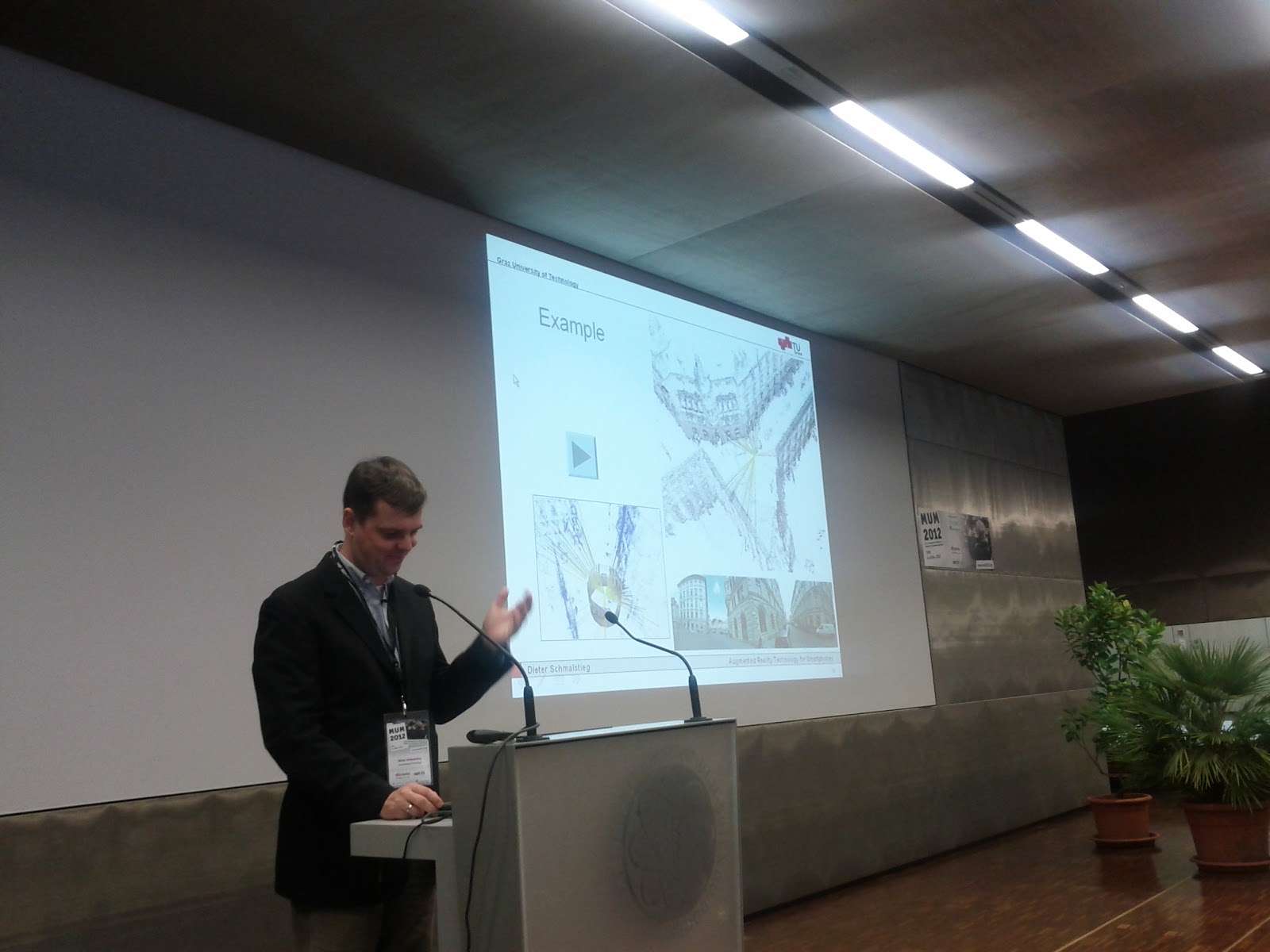
While I was absolutely amazed about the technical achievements of AR research I'm still struggling with recognizing meaningful applications of this technologies. In the subsequent session Dieter mentioned replacing today's habit googeling for keywords on the mobile by instant web searches based on context and situations the users is in and pointing to: AR could replace the text-field of Google search...

I believe AR is a fascinating research area and also a great tool. Combining the advancements of visual markers/sensors/localization should help to make AR a useful and intuitive experience for accessing digital services in mobile user contexts.
Throughout the three days there was interesting work presented on novel design, mobile interaction, social interaction, security, mobile augmented reality, tools, audio, field studies, and public displays (see program). As part of these sessions I was presenting our work object circles which proposes to use the Google+ Circle concept for visualizing and managing data streams of smart items as an intuitive metaphor for everyday users. The underlying principle is to use the established interface of social media to also manage and interact with items and devices [1]. In addition to that, as part of the industry track, I presented our evaluation of the Dacuda scanmouse where could prove the more effective use of this device for everyday scanning tasks compared to multi-function printers, personal scanners, and mobile phone image taking [2]. Instead of a prototype I could actually show the working product which clearly showed to me the power of demonstrations. Let's see how many visitors will buy such a mouse;)
Finally, Flavius Kehr presented our field study on evaluating capturing of driving behavior via smart-phone vs. built-in fixed unit [3]. His statistical analysis showed that the fixed unit has more accuracy, however, the measurements of the phone are still significant to provide feedback to driver about his driving behaviour. Thus, Flavius could conclude with the clear finding that mobile devices are well suited to elicit driving behavior. This opens the space for many other players, e.g. insurance companies, to provide driving feedback in addition to the built-in systems of car manufacturers.

Nigel Davies provided the second keynote of the conference, he showed his passion about public displays as part of his involved into the PD-net project. He started off with the general benefits of giving a keynote: it allows you to present results without being bound to a strict scientific methodology. Despite the ubiquitous emergence of displays in public areas all these devices still suffer major short-comings: people feel disturbed by aggressive ads, the systems are passive and don't allow for interaction. There are much smarter ways of using these expensive installations: build toolkits to allow interactivity, implement context sensitive information, support audit-trails and hand-over for strolling users across several displays. Nigel also showed how ideas and concepts may quickly become obsolete: the idea of setting bluetooth-friendly usernames appears to be ridiculous today but seemed to be completely reasonable a few years ago [4].
As scenarios for more interactive displays he proposed emergency search for missing children, emergency announcements, behavior changes (e.g. collect vouchers by by-passing) and local marketing. Public displays should be open for users he concluded. Challenged by the question of why display providers would open up their systems Nigel responded with the proposal of radically re-thinking the concept of how displays are being used today: instead of catching eyballs based on impressions they would be more integrated into users needs. Nigel drew the analogy of Google embedding ads into search results rather than catching eyeballs on the front page. Whether the ad companies are already ready for this now is hard to say, Nigel admitted, but it would be worth trying.Public displays (sometimes also referred to as digital signage) is a growing field, a research community with its own conference has already been formed: The International Symposium on Pervasive Displays, 4-5 June, 2013 - Mountain View, California.

[1] Florian Michahelles, Philip Probst: Object Circles: Modeling physical objects as social relationships, Proceedings of the 10th ACM SIGMOBILE Conference on Mobile and Ubiquitous Multimedia (MUM'12), Ulm, Germany, December 2012 [PDF].
[2] Matthias Wyss, Alexander Ilic, Florian Michahelles: The scanner at your finger tips - analysis of the effectiveness of the scan mouse device, Proceedings of the 10th ACM SIGMOBILE Conference on Mobile and Ubiquitous Multimedia (MUM'12), Ulm, Germany, December 2012 [PDF].
[3] Driving Behavior Analysis with Smartphones: Insights from a Controlled Field Study, Johannes Paefgen, Flavius Kehr, Yudan Zhai, Florian Michahelles, Proceedings of the 10th ACM SIGMOBILE Conference on Mobile and Ubiquitous Multimedia (MUM'12), Ulm, Germany, December 2012 [PDF].
[4] Nigel Davies, Adrian Friday, Peter Newman, Sarah Rutlidge, and Oliver Storz. 2009. Using bluetooth device names to support interaction in smart environments. In Proceedings of the 7th international conference on Mobile systems, applications, and services (MobiSys '09). ACM, New York, NY, USA, 151-164.

Monday, December 3, 2012

Panel Discussion: "How do users find my app?"


Thanks to Lars Erik Holmquist from Yahoo Labs I had the opportunity to host a panel on “The curse of choice – how do users find your apps” at Siggraph Asia 2012. Together with my follow colleagues from previous Research in the Large workshop Henriette Cramer, FrankBentley and Niels Henze, and with Jaden Choi from TGrape we had an interesting discussion on apps. 

Nan Zhong, master student at ETH Zurich, opened the panel with a general introduction to the head and longtail nature of markets (slides). Head markets follow the so-called Pareto-principle which builds upon the fact that shelf space is usually limited, such that the merchant has to choose wisely which products to put on displays. The general rule is that only 20% out of all products generated a 80% of total revenue, thus niche products have a hard chance to appear on the shelf. Opposite to that are longtail markets which generated most of the revenue out of a huge variety of less popular niche products. However, this is only possible in digital markets were shelf-space is virtually unlimited and transaction costs of managing all these products can be kept low. Nan investigated [1] the nature of the Google Play market based on data-set of Appaware and – surprisingly – found: in contrast to most other digital markets (Netflix, amazon…), Google play is a clear Head market with even stronger characteristics than traditional retail. Thus, Nan’s conclusion was that developers should clearly focus on developing blockbuster. Furthermore, he found that the average capacity of users to install apps is limited by average to 40 apps. This means an app has to be really good in order to make it most user’s phone. What’s more, only 28% of all users would download not more than one paid app. Thus, free apps are much more likely to be successful. Furthermore, successful apps are rated better in general, whereas niche apps are used by expert users who are more critical give lower scores. Nan closed his talk with the suggestion to develop mechanisms that allow niche to be found more easily, as current collaborative filtering techniques would rather push successful apps even further.
Inspired by these insights we discussed various strategies of how developers could foster that their apps get found. Niels proposed to focus on search engine optimization by trying to understand how Google would rank apps. Thus, building up a history of a developer account releasing several successful apps overtime might help as well as tweaking the description of apps. Frank reported about his experience [2] of professionally marketing apps as any other product by approaching influential blogs launch posts that could trigger the demand for the app. Henriette proposed [4] to build upon the sharing friends by making apps social and allowing to be propagated by digital word of mouth.
We continued with the question of the price and Jaden Choi disclosed that he sees price rather following quality of the app. Price wouldn’t really matter so much, is rather a decision between paid and free app. Nan confirmed this finding saying that the 99cent price would be rather a relict of itunes than based on rational thinking. Also his research didn’t really reveal much experimentation of developers with adapting the price of apps. Jaden added that especially in Korea in-app payment for virtual gadgets would be strong opportunity and even more successful than having a paid app.
Niels disclosed his experience of releasing apps on Sunday [3] evening as the most effective measure getting users’ attention. Based on our experience with AppAware I mentioned that creating localized clones yourself from or own could be another approach to be found more easily in various languages and to get better positions in local app markets.
The fundamental question of developing interesting and new apps in the plethora of existing apps Frank answered by reverting on established methods of ethnography and experimentation. One approach would be to go out and observe users in order to get a glance what they might need. The next step then would be to “fail early”, meaning to release in short cycles and to learn from user comments to improve quickly.
Another interesting insight to me was that more expensive devices might also allow for more expensive apps. Finally, we had some controversy discussion about whether apps would prevail or rather be replaced by HTML5 web apps. The arguments by Frank (pro apps) and Niels (pro web-apps) where along the lines of barrier to install apps and technical flexibility of accessing hardware functions on the phone.
Overall, the panel together with about 50 visitors seemed to have been a good add-on at the Siggraph Asia conference. The App Symposium will be continued as a SiggraphMobile in 2013.
Additionally, Siggraph Asia was featuring an Emerging Technologies section. Different demos could be tried out proving new developments or also art and entertainment projects. My takes were controlling and seeing through a drone by a head-mounted display, “tasting” a website's ingredients (links, pics, bandwidth) as mixed liquor, an interface for controlling dancing robots, a force-sensitive display, an actuator game, and breath-awareness through a baloon.
Additionally, the Siggraph exhibition
featured a humanoid robot demo where a user's face gets project onto a mannequin representing a proxy of the user in meeting. <

Apart from that, Singapore is a fascinating place, an island of wealth, luxury, and strange rules in the heart of Asia. I really enjoyed the visit of the conference in Singapore. 

[1] Where should You Focus: Long Tail or Superstar?, An analysis of app adoption on the Android Market, Nan Zhong, Florian Michahelles. Symposium on Apps at Siggraph Asia, Singapore, November, 2012. [pdf] [slides]
[2] Frank Bentley, Santosh Basapur:   StoryPlace.Me: the path from studying elder communication to a public location-based video service, CHI EA '12, CHI '12 Extended Abstracts on Human Factors in Computing Systems, 2012 
[3] Niels Henze, Susanne Boll: Release Your App on Sunday Eve: Finding the Best Time to Deploy Apps (poster), Adjunct proceedings of MobileHCI, 2011
[4] Henriette Cramer, Mattias Rost, Lars Erik Holmquist (2011) Performing a Check-in: Emerging Practices, Norms and ‘Conflicts’ in Location-Sharing Using Foursquare. Proc. MobileHCI’11, Stockholm, Sweden. pdf

NFC Congress 2012

 It was the third time I attended the NFC Congress at FH Hagenberg. I was happy to meet so many people still believing in the opportunities of this technology even though actual deployment is still progressing slowly. I attended the congress one day before the announcement of Apple’s iphone, but there seemed to be pretty much consensus that Apple will not be a driver of this technology either.
 It was good to see how Nokia’s development of NFC finally got integrated into Microsoft’s Proximity API of Windows 8 which markets NFC as user experience instead of technical modes and parameters. However, the importance of windows mobile among Android and iOS still remains speculation. Payment is still seen as the main driver – or currently the main show stopper – of NFC. Several talks pointed out the roadmap for NFC as starting with wireless cards being rolled out mainly in eastern and southern Europe, next would be NFC stickers on phones, and finally the full integrated into the phone.
There the challenge will be to group service around payment such as coupons, loyalty, promotion, transport in order to incentivize consumers to switch from established payment methods – in Germany mainly cash – to mobile payments.
Finally, NFC was also proposed for micro-merchants as an alternative to transaction terminals, I enjoyed the split screen application for taxi-drivers presented by the Sparkassen Verlag Overall, the time horizon of greater adoption still remains unclear. Most participants, however, shared the believe that NFC would come sooner or later, mostly driven by the introduction of wireless cards which might be substituated by NFC later. Thus, I’m already looking forward to the NFC 2013 workshop which is technically co-sponsored by IEEE Switzerland Section and will take place in Zurich, Switzerland.

Technology Transfer in Poland


Poznan was my first visit of Poland. I was invited to talk about the technology transfer practice at ETH Zurich as part of the Opencode Transfer project which deals with the development of a new technology transfer process for Polish universities in greater Poznan region.
 I was presenting on the characteristics of ETH Zurich’s spin-offs such as longer survival rates, job creation, and value generation as the main motivation for fostering entrepreneurship at universities.

Throughout the following panel discussion I learned about significant differences between Poland, Switzerland and US. Whereas ETH transfer mainly functions as a service center supporting ETH employees to commercialize scientific results, in Poland university rather see transfer offices as profit centers which should generate surpluses out of licenses, patents and shares of spin-offs. Also other participants underlined that this approach might be hardly successful when looking at the numbers of US universities such as Stanford or Univ. of Illinois, where only 4% of submitted patents finally materialize in transferred licenses.
Overall, I was fascinated by the entrepreneurial spirit and the strong ambition of technology transfer from research to practice in Poznan.   

Tuesday, November 20, 2012

GS1 Technology Day: Nano, robots, humanoid reproduction

For the first time the leaders of the GS1 EPCglobal Board of Governors met at ETH Zurich for discussing future directions of RFID and barcode technologies. As part of this meeting, we organized a technology day which featured current develops of our labs associated companies and groups (find presentations and detailed agenda here).
In addition to our own work we could also invite renown keynote speakers from ETH Zurich.
Prof. Dr. Bertram Batlogg talked about recent developments of nano-technology and shared some insights about emerging display technologies.
As part of this program we had also the chance to meet Prof. Dr. Raffaello D’Andrea who motivated his research on controlling robots by sensors by the example of the steam engine controlled by a speed limiter.
Raffaello showed the tremendous developments regarding miniaturization when he compared their most recent quadrocopter with the table-sized model of a decade ago.
However, during his robot air-show the title of his talk "Controlling the artificial" become even clearer: Raefaello showed his trust into his technologies when he took a seat in his Flying Machine Arena and his students started the show, sometimes closely above his head.

In the first demo our visitors could control the helicopter with a stick by gestures. The system ensured that the helicopters did not collide with the walls or crash down because of too hectic movements. Other demos showed the ability of balancing a standing stick on the helicopter, coordinated movements of groups, kinect gesture control and the famous ball juggling (see here). Thus, this demonstration made me confident about getting the next doener delivered by drone pretty soon....
Finally, Prof. Dr. Markus Gross talked about how to visually reproduce the real-world based on special effects in several animation movies. He reported about the ability of 3D-scanning of still faces and reproducing movements with 7 artificial muscles in contrast to the natural 35 muscles. His prophecy was that in about a five year's time horizon simulated face-movements would be indistinguishable from the real. Thus, Holywood stars would already start protecting the rights on the visual appearance of their bodies, as movements can be done by the computers later rather easily and more cost-efficient.
In the second part of his talk Prof. Gross talked about humanoid robots that would mimic actors in amusements parks. Based on 3D scans and 3D printing faces can be modeled quickly. As a commercialization of this technology he showed customized barbie puppets carrying faces of the corresponding children. Technological progress sometimes can be fascinating and scary...


Friday, November 16, 2012

White collar crime


In my lecture management information systems Michael Schermann from Lehrstuhl für Wirtschaftsinformatik of Technische Universität München presented on the incentives of in-company crime and instruments for preventing it.
He started off with the traditional explanation of crime where criminals would simply balance between their crime incentive and the opportunity of being punished. Thus, high punishment would be enough to move the balance and ban crime...
However, from practice and from recent experiments we know this does not really hold. People rather have a moral account from where they withdraw and upload credits for their activities: if you buy green, you're more likely to steal...[1].
Furthermore, the simple cost/benefit analysis of fraud is also overwritten by an inner concept relating to fraud of users. It could be shown that fraud outside one's peer-group is less accepted than one's inside peer-group [2].
As example of fraud Michael listed corruption, higher billing of services/products, and non-cash fraud, e.g. manipulation of salaries - he said 15% of salaries would be adjusted higher than they should be. This shows that the traditional concept of incentive-punishment does not hold and is rather being replaced with an inner self-concept of values: if people park illegally, they are more prone to donate to beggar - in order to compensate their wrong behavior by adjusting their moral inner account.
Interestingly, most fraud is detected by hints of others. Thus, companies have started introducing whistle blower channels in order to collect these hints in a more systematic way. Michael proposed to translate business strategy into core values, which have to be lived up by top-management. There should be a clear list of don'ts to be avoided in companies. Control in companies can focus either on input (if output is hard to measure, e.g. as in research) or on input (e.g. sales).
The practical challenge, however, is to smartly balance between burden and effect. IT can help to better manage and control performance and coherence in order to be more responsive to risks, e.g. software can help to crunch down 126k of suspect emails down to a 1,2k messages.
Michael's slides can be found here.
 
[1] Nina Mazar and Chen-Bo Zhong: Do Green Products Make Us Better People? Psychological Science February 2010 , first published on March 5, 2010 
[2] Gino, F., Ayal, S. & Ariely, D. (2009). Contagion and differentiation in unethical behavior: The effect of one bad apple on the barrel. Psychological Science, 20 (3), 393-398.
ariely: coke was gone, dollar where there -) distance to money increases crime