Showing posts with label consumer. Show all posts

Tuesday, April 23, 2013

Streetspotr - the mechanical turk in the wild

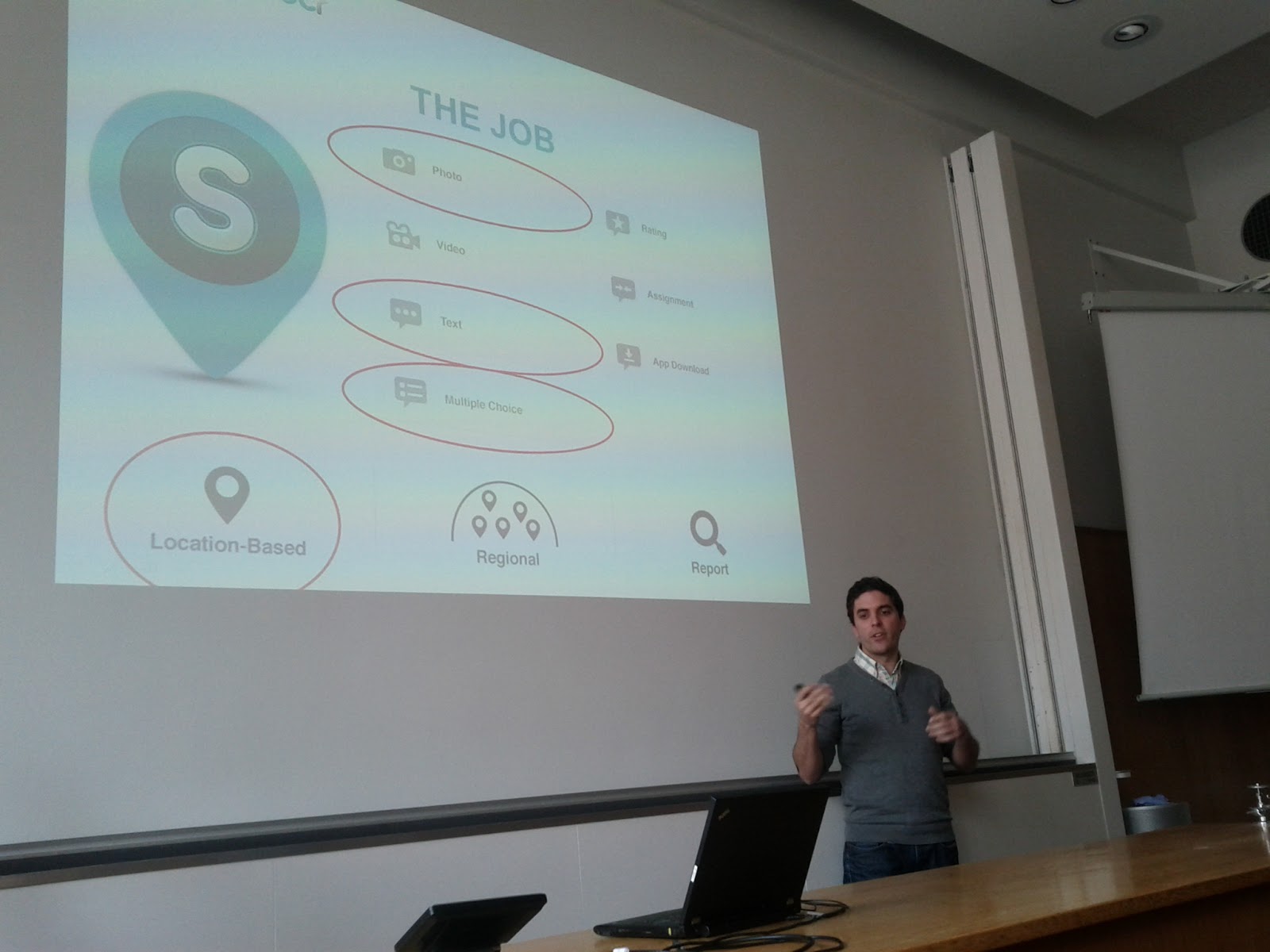
As part of my lecture Businees Aspects of the Internet of Things I could welcome Werner Hoier and Dorothea Utzt from Streetspotr.com as guest lecturers (slides).
They shared some interesting insights about their start-up which implements the idea of match-making between location-based micro-task issuing and fullfilling (as described earlier by [1]). Having reached out to 180k users who are only waiting for earning some fractions of a EURO by solving tasks like "take a picture of the menu in restaurant", "collect the GPS location of a parking lot", or "check the availability of an ATM". Without marketing but mostly relying on public media and blogs who featured their story they could build up their user base.
Interesting enough they are no longer looking for more users but rather for more job issuers. Also, so far they refrained from allowing to share user-to-user services. Their service nicely extends traditional services of market survey agencies. They reported about their most successful user who already earned a 600 EUR on their platform.

I'm really curious how this micro-task business evolves. I could well see opportunities for people waiting or being stuck somewhere and either earn money or giving something back by solving small little tasks in their downtime. Furthermore, finding a proper alignment between situation of the user and available tasks and corresponding rewards should be key to success, see also [2].

[1] Florian Alt, Alireza Sahami Shirazi, Albrecht Schmidt, Urs Kramer, and Zahid Nawaz. 2010. Location-based crowdsourcing: extending crowdsourcing to the real world. In Proceedings of the 6th Nordic Conference on Human-Computer Interaction: Extending Boundaries (NordiCHI '10). link
[2] Navkar Samdaria, Akhil Mathur, and Ravin Balakrishnan. 2012. Paying in kind for crowdsourced work in developing regions. In Proceedings of the 10th international conference on Pervasive Computing (Pervasive'12), Judy Kay, Paul Lukowicz, Hideyuki Tokuda, Patrick Olivier, and Antonio Krüger (Eds.). link

Friday, October 23, 2009

Towards a Do-it-yourself-Internet of Things

I'm quite happy about my recent purchase of Sonos, an always on network stereo, that streams music from any source (NAS, internet radio, etc.) to my home without requiring a computer. For me it's the first embedding of streams into my physical home.
Simultaneously, I'm quite proud about the doll's kitchen I build for my daugther from standard components you can get in a hardware store.

I also have a couple of ideas concerning improvements of the Sonos interace, coupling of my Sonos with location information and alike. I'm wondering how long it still takes until laymen can build and extend Internet services embedded in physical environments using standard components and tools - similarly, as I could for building the doll's kitchen. Probably still along way to go - that's why we're submitting a project proposal about that to the EU today...

Thursday, August 6, 2009

Lost & Found - a case for the internet of things for the consumers

I just received a call from my wife when she left a suitcase in the tramway. She was busy with our two kids and only remembered the suitcase when the doors had been closed and the tram departed. Since I have the schedule of all public transport on my mobile, it was no problem for me to hunt for the tram taking some short-cuts with my bicycle. However, since I was too late to catch it I just decided to wait a few stations further down until the tram would turn and come back - that I could reason precisely from the schedule. What I did was a 'virtual track&trace' which works excellent in Switzerland since the planned schedules really match the as-is-situation most of the time.
However, the uncertainty we still had was what would happen, if the driver would detect the unattended luggage, take it out and send it to the lost&found office - we would loose a day in retrieval, as it would go there into storage room according to a defined process as my wife found out when asking at that office. Also they do not allow to communicate with the driver as this would disturb his process of driving (just imagine the communication load for all items being lost in Zurich everyday!).
Thus, wouldn't it be great, if you could initiate an ad-hoc real-time track and trace yourself of your belongings [1]? Or, if you could have a better way of communicating with other people that find your lost items and have the good mind of helping you [2]?
I'm convinced that this could be really a valuable case for the internet of things for consumers (and all that desperate people would be also happy to pay a reasonable fee for that service, e.g. keymail).
In our case: we had been lucky, the suitcase just came back with tram I reasoned from the schedule and everything was fine.

[1] C. Frank, P. Bollinger, C. Roduner, and W. Kellerer: “Objects Calling Home: Locating Objects Using Mobile Phones”, in: Proceedings of Pervasive ’07, Toronto, Canada, 2007.
[2] Guinard, D., Baecker, O., & Michahelles, F. (2008). Supporting a Mobile Lost and Found Community. In Proceedings of the 10th International Conference on Human-Computer Interaction with Mobile Devices and Services (pp. 407-410). New York.